 Cardex
How to check Pokémon card value in 60 seconds
Quick answer: find the exact printing (set, collector number and variant), check its condition, then look up recent sold prices for that exact card. Most cards are worth very little: about 7 in 10 cards from recent Scarlet & Violet and Mega Evolution sets sell for under $1, and a modern common goes for about 14 cents. The cards worth real money are Special Illustration Rares (median $29), Illustration Rares (median $9.95), alternate art and rainbow cards from Sword & Shield, and holos from 1999 to 2003, which sell for $40 or more even as unlimited copies.
- Identify the card: read the set symbol and the collector number in the bottom corner (for example 199/165), and note whether it's holo, reverse holo or 1st Edition.
- Check the condition: look at the edges, corners and surface under a bright light. The prices you see online are for near-mint copies.
- Look up sold prices: compare what buyers actually paid for that printing on eBay, TCGplayer or Cardmarket, or scan the card to see them in one place.

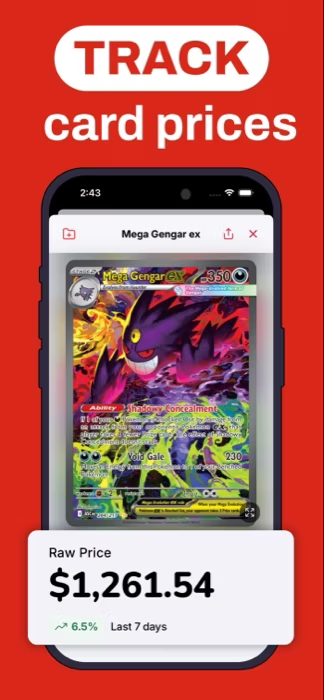
Card in front of you? Scan it with Cardex to identify the exact printing and see its current price. See how it works.
Get the free appScanning covers all three steps at once. Cardex is free on iPhone and Android:
- Open Cardex and point the camera at the card. Automatic scanning picks it up without a button press.
- It identifies the exact card and variant, so you don't mistake a $1 regular print for the $300 version of the same Pokémon.
- You get its raw market price, eBay, TCGplayer and Cardmarket prices side by side, and a 7-day price chart. Graded prices, the full list of recent eBay sales and longer price history come with Cardex Premium.
Check your card's value right now
Cardex is free to download. Scan a card to identify it and see what it sells for, without searching through listings.


What Pokémon cards are worth by rarity
We take the near-mint market price of every English card from the Scarlet & Violet and Mega Evolution sets and group the cards by the rarity printed on them. The median is the card in the middle: half of that rarity sells for less, half for more. The middle-half column shows where the central 50% of cards sit. Prices updated October 30, 2026.
| Rarity | Cards | Median | Middle half | Worth $10+ | Worth $100+ |
|---|---|---|---|---|---|
| Common | 1,473 | $0.14 | $0.11 to $0.18 | 0% | 0% |
| Uncommon | 994 | $0.15 | $0.11 to $0.19 | 0.2% | 0% |
| Rare | 366 | $0.21 | $0.17 to $0.28 | 4.4% | 0% |
| ACE SPEC Rare | 33 | $0.50 | $0.35 to $1.27 | 9.1% | 0% |
| Double Rare (ex) | 329 | $0.71 | $0.59 to $0.99 | 0% | 0% |
| Shiny Ultra Rare | 12 | $1.74 | $1.18 to $2.46 | 8.3% | 0% |
| Ultra Rare (full art) | 356 | $2.09 | $1.19 to $3.75 | 5.1% | 0% |
| Shiny Rare | 120 | $4.52 | $2.90 to $8.44 | 21% | 0% |
| Mega Attack Rare | 7 | $4.82 | $2.99 to $5.61 | 29% | 0% |
| Hyper Rare (gold) | 74 | $7.81 | $4.46 to $11.75 | 35% | 0% |
| Illustration Rare | 510 | $9.95 | $4.76 to $18.81 | 50% | 0.4% |
| Special Illustration Rare | 232 | $29.47 | $16.91 to $58.71 | 91% | 16% |
| Mega Hyper Rare | 8 | $153.40 | $112.85 to $183.68 | 100% | 88% |
A few rows catch people out. The ex cards with two black stars (Double Rare) have a median of 71 cents, and the most expensive one sells for $8.61. Gold Hyper Rares sell for less than Illustration Rares ($7.81 against $9.95), even though you pull far fewer of them. Reverse holo commons and uncommons have a median of 24 cents, and only 1.5% of them reach a dollar.
Special Illustration Rares are the exception. 91% of them are worth $10 or more and 16% are worth $100 or more, so any card with two gold stars deserves its own price check. If you can't tell the symbols apart, our rarity symbols guide shows each one.
Sword & Shield cards (2020 to 2023)
If your cards came from the 2020 to 2022 boom, these are the rarities to look for. Before Scarlet & Violet, ultra rare cards carried a white star instead of colored ones, so the symbol alone won't separate a $1 V card from a $400 alternate art. The name and the artwork will.
| Rarity | Cards | Median | Middle half | Worth $10+ | Worth $100+ |
|---|---|---|---|---|---|
| Common and Uncommon | 1,422 | $0.13 | $0.09 to $0.18 | 0% | 0% |
| Holo Rare | 270 | $0.34 | $0.28 to $0.43 | 0.7% | 0% |
| V | 281 | $0.98 | $0.80 to $2.59 | 11% | 0.7% |
| VSTAR | 43 | $1.88 | $1.35 to $10.50 | 28% | 2.3% |
| VMAX | 110 | $3.89 | $1.78 to $10.62 | 26% | 1.8% |
| Full art and alternate art V | 356 | $4.41 | $2.38 to $12.20 | 29% | 4.2% |
| Trainer Gallery | 80 | $5.13 | $3.03 to $10.55 | 28% | 0% |
| Gold secret rare | 105 | $5.19 | $2.51 to $13.71 | 33% | 4.8% |
| Rainbow and secret alternate art VMAX | 180 | $8.29 | $5.45 to $15.69 | 39% | 7.2% |
Two rows mix cheap and expensive cards. Regular full art cards share a rarity with alternate art V cards, and rainbow cards share one with the secret alternate art VMAX cards. The alternate arts, where the artwork spills past the usual frame, are the expensive ones: Giratina V 186/196 from Lost Origin sells for $822, and Umbreon VMAX 215/203 from Evolving Skies sells for $2,210.
Is my Pokémon card worth anything? Check when it was printed
Age matters more than most people expect. Here's the same price data split by era, covering 19,151 English cards with a near-mint price:
| Era | Cards | Median card | Under $1 | Worth $10+ | Worth $100+ |
|---|---|---|---|---|---|
| Scarlet & Violet and Mega Evolution (2023 to 2026) | 4,583 | $0.21 | 69% | 13% | 1.2% |
| Sword & Shield (2020 to 2023) | 3,363 | $0.27 | 65% | 9.8% | 1.2% |
| Black & White to Sun & Moon (2011 to 2019) | 5,834 | $0.51 | 61% | 18% | 4.2% |
| EX to HeartGold SoulSilver (2003 to 2010) | 3,645 | $2.31 | 32% | 29% | 8.9% |
| Wizards of the Coast (1999 to 2003) | 1,726 | $7.42 | 14% | 43% | 12% |
These numbers count each printing once, not each copy. Commons were printed in far bigger runs than rares, so in a real shoebox the share of cards under $1 is higher than the table shows. The pattern still holds: older cards are worth more on average, and cards from 2003 to 2010 (the EX, Diamond & Pearl, Platinum and HeartGold SoulSilver sets) are worth a second look even when they aren't holo.
The same Pokémon can be worth 25 cents or $1,000
The name and the artwork don't tell you the price. The set and the number do. A few examples from current sets:
- Pikachu is on 53 cards in Scarlet & Violet and Mega Evolution sets. The cheapest, Pikachu 055/217 from Ascended Heroes, sells for 25 cents. The most expensive, Pikachu ex 276/217 from Ascended Heroes, sells for $613.
- Charizard ex runs from $4.50 for 054/091 from Paldean Fates to $300 for 199/165 from Scarlet & Violet 151.
- Umbreon ex 060/131 from Prismatic Evolutions sells for $7.64. Umbreon ex 161/131 from the same set sells for $1,137.
- Base Set Charizard artwork was reprinted in Celebrations (2021) and in the 30th Celebration Classic Collection (2026). Those reprints sell for about $128 to $147. An original 1999 copy sells for several times that, so check the set and the copyright line before you get excited, or before you sell one cheaply.
Which version do you have? Scan the card with Cardex and it reads the set and number for you, then shows the price of that exact printing. See how it works.
Get the free appWhat is my old Pokémon card worth? (1999 to 2003)
Cards from the Wizards of the Coast era hold the biggest surprises, and mix-ups cost the most here. Typical near-mint prices for unlimited copies (not 1st Edition) from the early sets:
| Rarity | Jungle | Fossil | Team Rocket | Neo Genesis |
|---|---|---|---|---|
| Common | $0.51 | $0.52 | $0.79 | $0.91 |
| Uncommon | $1.50 | $1.41 | $2.25 | $1.88 |
| Rare (no holo) | $8.04 | $8.98 | $9.63 | $4.17 |
| Holo Rare | $41 | $41 | $46 | $64 |
Median near-mint price per rarity. Then check these four things, because each one moves the price a lot:
- 1st Edition stamp: a small black circle reading "Edition 1" just below the left corner of the artwork. Across 830 cards from Jungle, Fossil, Team Rocket, the Gym sets and the Neo sets, the 1st Edition copy sold for a median of 2.8 times the unlimited one. For holos it was 2.6 times, and most fell between 1.9 and 3.3 times.
- No set symbol: a 1999 card with no symbol on the right below the artwork is from Base Set, the first English set.
- Shadowless: early Base Set cards have no drop shadow along the right edge of the art box. They come from a short print run and sell for more than the regular unlimited copy.
- Condition: most of these cards were played with. A holo with heavy edge wear and scratches is worth a fraction of a clean one, so compare it with sales in the same condition.
The last Wizards sets (Expedition, Aquapolis and Skyridge, from 2002 and 2003) had much smaller print runs, so even their commons sell for several dollars. Skyridge commons have a median of about $26. Our guide to the most valuable Pokémon sets ranks every set by total value.
How condition changes the price
The prices above are for near-mint copies. When we compared condition prices across about 9,000 cards, worn copies sold for these shares of the near-mint price:
| Condition | What it looks like | Median share of NM price |
|---|---|---|
| Near Mint (NM) | Clean edges, sharp corners, no visible scratches | 100% |
| Lightly Played (LP) | A little edge whitening or a light scratch | 76% |
| Moderately Played (MP) | Clear whitening, several scratches, minor bends | 57% |
| Heavily Played (HP) | Heavy wear, creases, stains | 40% |
| Damaged (DMG) | Tears, water damage, writing | 35% |
For a 20-cent card none of this matters. For a $300 card, LP instead of NM is roughly a $70 difference, so look at it under good light before you settle on a price. Our guide to NM, LP, MP and HP has the full breakdown, and the condition guide shows what to look for on each part of the card.
Raw vs graded value
A raw card is an ungraded card. A graded card has been authenticated and scored by a company such as PSA, CGC or Beckett and sealed in a slab. High grades on valuable cards can sell for several times the raw price, while low grades are often worth less than the raw card once you subtract the grading fee. Before you send anything in, read raw versus graded Pokémon card prices and is my Pokémon card worth grading. Cardex Premium shows raw and graded prices side by side for the same card.
Why asking prices and old price guides mislead
The most common mistake is typing the card name into eBay and trusting the first prices that come up. Those are asking prices, and anyone can list a $3 card for $300. Two fixes:
- Use sold prices only. On eBay, filter for sold items. Our guide to checking recent Pokémon card sales shows how.
- Match the exact printing and condition. A sale of the graded 1st Edition holo tells you nothing about your unlimited, played, non-holo copy.
Printed price guides and year-old articles have the opposite problem. Modern chase cards can halve or double within months of a set's release, so last year's number is a guess at best. That's why the tables on this page are refreshed every day.
Ways to check a Pokémon card's value
| Method | Speed | Watch out for |
|---|---|---|
| Scan with Cardex | Seconds per card | Identifies the exact variant for you. Raw prices and eBay, TCGplayer and Cardmarket prices are free; graded prices and the full sales list are Premium. |
| eBay sold listings | Minutes per card | Easy to match the wrong variant, and you have to filter out graded and damaged copies yourself. |
| TCGplayer or Cardmarket | Minutes per card | One marketplace's view only. TCGplayer is US-focused and Cardmarket is European. |
| Printed price guides | Fast | Out of date by the time they're printed. |
Pricing a whole binder or box
Pricing one card is a search. Pricing a binder is a project, and almost all the value sits in a handful of cards. Sort before you price:
- Pull everything that shines: holos, full arts, gold and rainbow cards.
- Pull every card with a tag after its name: ex, EX, GX, V, VMAX, VSTAR, LV.X, BREAK, Prime or LEGEND.
- Pull every card numbered above its set size (for example 210/198). These are secret rares.
- Pull anything from 1999 to 2010. Check the copyright line at the bottom.
- Price the pulled pile card by card and treat the rest as bulk.
Our guide to what a whole Pokémon collection is worth covers the bulk math and what shops and buylists actually pay.
Where these numbers come from
We pull near-mint USD market prices for every English Pokémon card from the same price data the Cardex app uses, and refresh this page every day. The latest update (October 30, 2026) covers 19,151 cards across 148 sets. Promo lines, energy sets, trainer kits, McDonald's sets and other non-expansion products are left out. Each card counts once, at the price of its main printing; for 1999 to 2003 cards we use the unlimited copy wherever one exists. Read the medians as what's typical, not as a quote for your card.
Pokémon card value questions
Is my Pokémon card worth anything?
Probably a little, possibly a lot. About 7 in 10 cards from recent sets sell for under $1. The signs of a valuable card are gold or colored stars next to the collector number, a collector number above the set size (like 199/165), full artwork that covers the whole card, or a copyright date from 1999 to 2010. If none of those apply, it's most likely bulk.
How do I check the value of my Pokémon cards for free?
Search eBay's sold listings for the card name, set and number, which is free but slow for more than a few cards. Cardex is free to download: you can search any card to see its raw price and its eBay, TCGplayer and Cardmarket prices, and your first 3 scans are free. Unlimited scanning and graded prices come with Cardex Premium.
How much is a holo Pokémon card worth?
It depends on the era. A regular holo rare from Sword & Shield has a median of 34 cents. An unlimited holo from Jungle, Fossil and Team Rocket (1999 to 2000) has a median of $41 to $46, and 1st Edition copies sell for about 2.6 times as much.
What are reverse holo Pokémon cards worth?
Usually well under a dollar for a modern common or uncommon. In our data the median reverse holo common or uncommon sells for 24 cents, and only 1.5% are worth $1 or more.
Are Pokémon cards from 1999 worth money?
Some are. Holos from the first sets sell for about $40 or more as unlimited copies, and 1st Edition and Shadowless copies sell for more. Commons from those sets go for about 51 to 91 cents each.
Which Pokémon cards are worth the most?
In modern sets, Special Illustration Rares of popular Pokémon: Umbreon ex 161/131 from Prismatic Evolutions sells for about $1,137. In older sets, 1st Edition holos from 1999 and 2000. Our list of the most expensive Pokémon card in every set shows the top card for each expansion, updated daily.
What to do once you know the value
- Worth a few dollars or less? Most cards are. Keep them for the collection, or put them toward a master set.
- Worth real money raw? Compare marketplaces before you sell. See where to sell Pokémon cards and how to price Pokémon cards for eBay.
- Valuable and near mint? Check whether grading would raise its value enough to cover the fee.
- Want to hold it? Add it to your Cardex collection and keep an eye on the price chart.