 Cardex
Quick answer: identify the exact printing first, then compare several recent completed sales for the same set, collector number, variant, condition and (if applicable) grading company and grade. Ignore active listings until you have a sold-price baseline.

Want sales for the exact card? Scan it with Cardex to identify the printing, then check recent eBay sales and current prices in one place. See how it works.
Get the free appWhy recent sales are more useful than asking prices
An active listing tells you what a seller wants. A completed sale is evidence of what a buyer paid at a particular moment. Neither is a permanent guarantee of value, but several closely matched recent sales give you a much more useful range than one ambitious listing.
eBay’s product-research tools distinguish sales data from active listings and let users narrow results by details such as condition and category. The same idea applies wherever you research cards: narrow the comparison before you draw a conclusion.
Where to check last sold prices
- eBay: search for the card and turn on the Sold items filter. eBay's own help calls these completed listings and also lists them under Advanced Search. This is the biggest pool of sales for both raw and graded cards.
- TCGplayer: each card's product page lists its latest sales on TCGplayer with the condition of each copy, which makes it a good check for raw cards.
- PriceCharting: collects eBay sales for each card and records the grade of each one, so it's quick when you want PSA 9 or PSA 10 comparisons.
Whichever you use, a sold price only helps once you know it's the same card in the same shape as yours. The steps below cover that.
Check Pokémon card sales in five steps
- Identify the exact printing. Confirm the Pokémon, set, collector number, language and variant. A regular print, reverse holo, promo and reprint can look similar but trade at different prices. Start with our Pokémon card set identification guide if you need help.
- Separate raw from graded cards. Do not use a PSA 10 sale to price an ungraded copy. If you are comparing graded cards, match the grader and numeric grade too.
- Match the condition. Compare a clean raw card with clean raw cards, not with visibly played, creased or damaged copies. See the Pokémon card condition guide for a practical condition checklist.
- Review several close matches. One sale may be unusual because of timing, auction format, shipping, an incomplete title or a condition detail hidden in the photos.
- Read the listings, not only the number. Check whether the sale was a single card, a lot, a bundle, a different language, a different variant or a different grade before using it as a comparable.
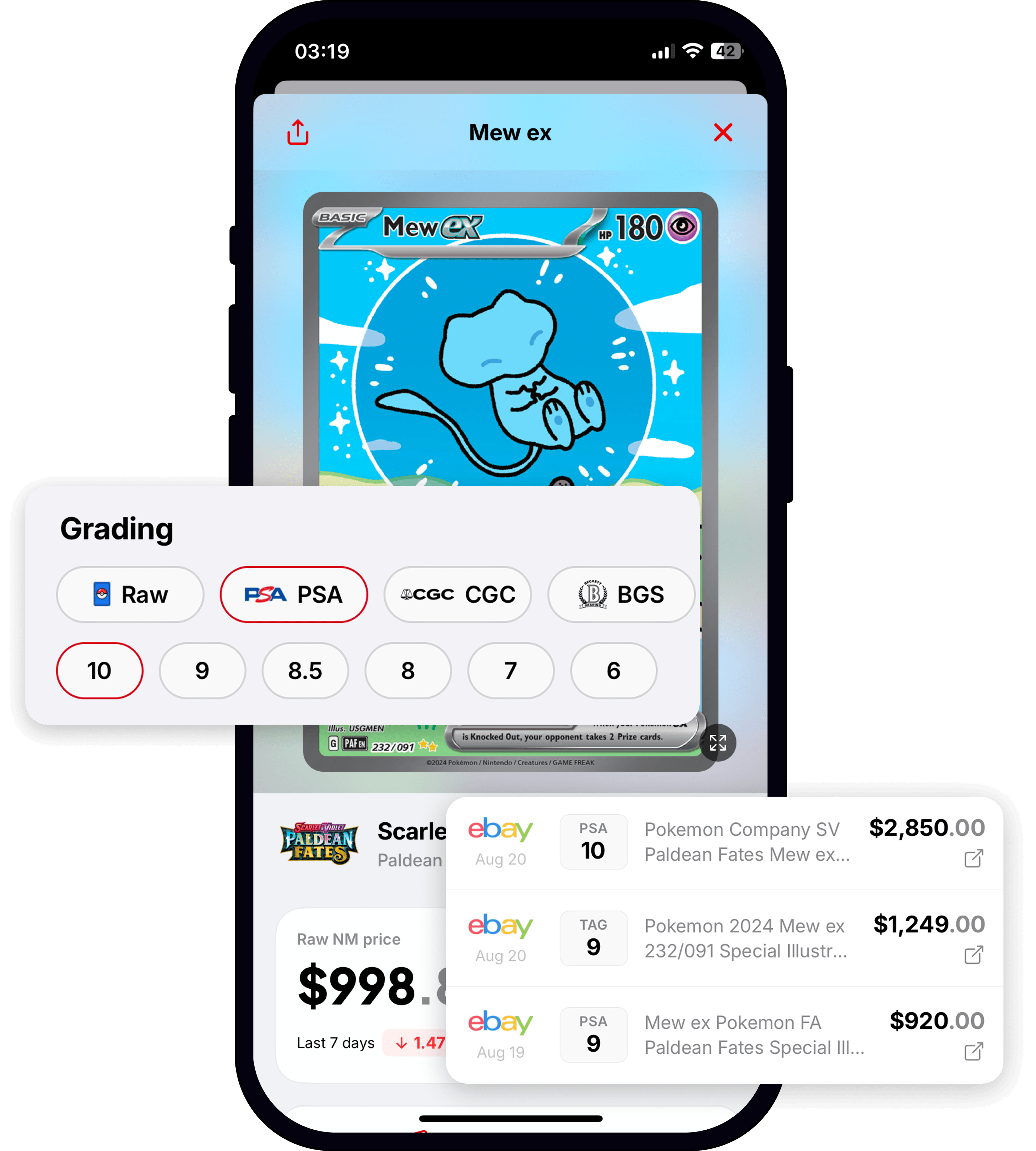
What must match before a sale is comparable?
| Match this | Why it matters |
|---|---|
| Set and collector number | The same Pokémon appears in many sets and printings. |
| Variant and language | Reverse holos, promos, 1st Editions, special printings and language versions can have separate markets. |
| Raw or graded status | An ungraded card and a slabbed card answer different pricing questions. |
| Grader and grade | A PSA 10, PSA 9, CGC 10 and BGS 10 should not be treated as one identical product. |
| Condition and sale format | Wear, creases, lots and bundled extras can make a headline price misleading. |
Use a range, not one magic number
After removing mismatches, look for a cluster of comparable sales. The goal is not to declare that every copy is worth an exact amount. It is to understand the range buyers have recently accepted for a card like yours.
Give more weight to recent, clearly described single-card sales with photos that support the stated condition. Treat old sales, unusual auctions and vague titles as context rather than a final answer. If there are only a few matches, say that the data is thin instead of forcing a precise value.
How to use Cardex for the first pass
Cardex is designed to reduce the identification work. Use automatic scanning to find the card, then review its current raw and graded price views and recent eBay sale information. Open the closest results and verify the details before deciding what to list, buy or submit for grading.
For a binder, repeat that workflow one card at a time and add cards to a collection tracker as you go. A tracker helps you keep the card identity and the price research connected instead of relying on memory or loose notes.
Start with the exact card
Scan with Cardex to identify the card, then compare raw and graded prices with recent eBay sale information before you buy, sell or grade.


Buying, selling and grading use the same research
If you are buying, comparable sales help you recognize a listing that is far outside the recent range. If you are selling, they help you choose a defensible starting point and describe the card accurately. If you are thinking about grading, use the same sales to compare a realistic raw value with sales for the grade your card could plausibly receive.
For that last comparison, read how to compare raw versus graded Pokémon card prices and whether a Pokémon card is worth grading. Neither guide can predict the grade a company will assign, but both help you avoid treating a top-grade sale as the default outcome.
Frequently asked questions
Do active Pokémon card listings show market value?
They can show what sellers are asking, but they do not prove that a buyer paid that amount. Use recent completed sales to build a baseline, then use active listings as additional context.
How many recent sales should I check?
Check several close matches where they exist. More matching sales make a range more useful; a single result may be an outlier or may include a detail that does not match your card.
Can I compare a raw card with a graded card?
You can compare them to understand a possible grading premium, but not to price them as the same item. Match raw cards with raw cards, and graded cards by the same card, grading company and grade.
Sources and further reading
- eBay: Product research: eBay’s overview of sales data, sold-price ranges and filters for researching item performance.
- PSA: Grading Standards: published grading definitions and condition factors to consider when comparing graded cards.