 Cardex

Weighing up a card? Cardex shows its raw price next to PSA and CGC graded prices, and AI Grading estimates a grade from photos. See how AI Grading works.
Get the free appGrading profit calculator
Search for your card to load its current raw and PSA prices and how often PSA has graded it a 10, or type in the numbers yourself. The calculator compares grading the card with simply selling it raw.
The starting numbers are a real card: Blastoise ex 200/165 from Scarlet & Violet 151, with today’s near-mint and PSA prices and the share of each grade among the 64,918 copies PSA has graded. Updated October 30, 2026.
The calculator assumes you'll sell the card either way, so the selling fee comes off the raw sale too. Every grade below 9 is priced as a PSA 8, so for cards that usually come back lower, such as most vintage holos, the real result is worse than shown. If you're keeping the card, set the selling fee to 0. The $59.99 grading fee is PSA's Standard tier, its cheapest open option on October 30, 2026 (the $39.99 Value tier is paused). Standard covers cards worth up to $1,000, so pricier cards need a higher tier; when you pick a card, the calculator switches to the tier its PSA 10 value needs. Fees change often, so check PSA's price list before you submit. Need the PSA 9 and 10 prices for your exact card? Cardex shows the raw price free, and Cardex Premium adds PSA, CGC and BGS prices plus an AI grade estimate from two photos.
The grading math in one paragraph
Grading services such as PSA, BGS and CGC charge per-card fees that vary by service level, declared value, membership and shipping. Check the grader's current schedule before submitting. The useful comparison is: (likely graded sale value) − (raw sale value) − (all submission and selling costs). Leave room for the possibility of a lower grade, because a grade is never guaranteed.
Step 1: Compare raw and graded prices
Everything starts with a realistic raw-versus-graded comparison:
- Open Cardex and scan the card.
- Compare the current raw and graded prices and review the card's price history.
- Check recent eBay sales alongside eBay, TCGplayer and Cardmarket data. Grading decisions deserve more than one marketplace's opinion.
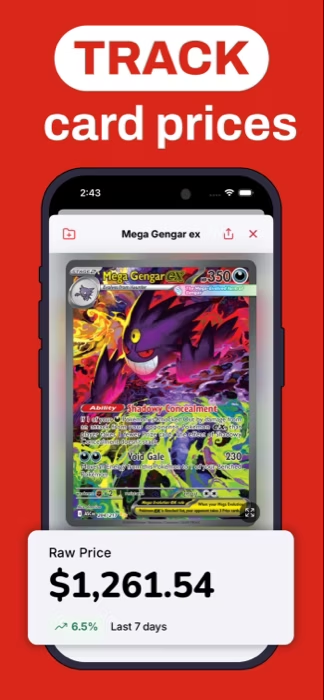
There is no universal price threshold for grading. Model the exact card, likely grade, service level and sale route instead. A modest raw value can still make sense when the graded premium is substantial; a high raw value can still be a poor candidate if condition makes the top grades unlikely.
Compare your card before grading
Download Cardex free and scan the card you're thinking about grading, then compare raw and graded prices, recent eBay sales and price history before you submit.


Step 2: Be brutal about condition
The graded premium lives almost entirely in the top grades. Before paying a fee, use our Pokémon card condition guide and inspect under strong light:
- Centering: are the borders even on front and back? Off-centering caps the grade.
- Edges & corners: whitening on the back edges is the most common gem-killer.
- Surface: holo scratches, print lines, fingerprints, indentations.
- Creases: any crease, even tiny, removes the card from mint territory entirely.
If you spot a clear flaw, compare sales at realistic lower grades rather than assuming a top grade. That often changes the economics immediately.
Step 3: Sanity-check the graded premium
Check recent eBay sales for your exact card at the grades you are considering. Cardex surfaces recent eBay sale information for the scanned card; make sure you are comparing the identical set, number, variant and grade (a reprint can look identical and be worth 10× less; see identifying your card).
Which cards are usually worth grading?
- Modern chase cards in pack-fresh condition: Special Illustration Rares, Hyper Rares and popular Ultra Rares (see cards worth money).
- Vintage holos: WOTC-era rares, especially 1st Edition/Shadowless, where even mid grades carry value.
- Iconic Pokémon: Charizard, Pikachu, Umbreon and friends have the deepest graded markets.
- Cards you're keeping long-term: a slab also protects and authenticates, which has value beyond resale.
Which cards usually aren't?
- Cards with little realistic graded premium after all submission and selling costs.
- Anything with a visible crease, heavy whitening or holo scratches.
- Cards whose market data is weakening when you would need a strong graded premium to justify the costs.
Need a cleaner way to read the numbers? See our guide to comparing raw and graded Pokémon card prices before you submit.
Grading costs: what to budget before you submit
The fee on the grader's price list is only part of the cost. A realistic budget for one card looks like this:
| Cost | What it covers | Typical range |
|---|---|---|
| Grading fee | Per-card fee, priced by service level and declared value. Bulk and economy tiers are cheapest, high-value tiers cost far more. | PSA's cheapest open tier is $59.99 per card for cards up to $1,000 (October 30, 2026; its $39.99 Value tier is paused). Pricier cards need tiers from $79.99 up |
| Membership | Some graders require or discount through an annual membership | Varies; often waived for bulk submissions through a shop |
| Shipping to the grader | Tracked, insured shipping of the raw cards | $10 to $30 per package, shared across the cards you send |
| Return shipping | Slabs are heavier and insured for declared value | $15 to $50 per package |
| Selling costs | Marketplace fee and shipping when you sell the slab | Roughly 10 to 15 percent of the sale on eBay or TCGplayer |
| Time | Turnaround from weeks to months depending on tier; the market can move while you wait | Not a cash cost, but real |
Add these up per card, not per submission, and compare the total against the graded premium. Grading services publish current fee schedules; check them the day you submit because tiers and turnaround times change often.
A worked example
Take Blastoise ex 200/165 from Scarlet & Violet 151, a Special Illustration Rare. Today it sells for about $109.11 raw in near-mint condition, $515.54 as a PSA 10, $141.54 as a PSA 9 and $103.75 as a PSA 8. PSA’s Standard tier costs $59.99 per card, shipping adds roughly $10, and selling on eBay costs about 13% of the sale either way. Selling it raw leaves you $94.93.
- If it grades a 10: $448.52 after the selling fee, minus $69.99 in costs, is $283.60 more than selling raw.
- If it grades a 9: $123.14 minus $69.99 is $41.78 less than selling raw.
- If it grades an 8: $90.26 minus $69.99 is $74.65 less than selling raw.
Of the 64,918 copies PSA has graded, about 29% came back as 10s and 50% as 9s. At those odds grading comes out about $45.68 ahead per card on average. You’d need roughly a 16% chance of a 10 just to break even. Those population numbers flatter your odds, though: people mostly send copies they already think are clean, so a card pulled from a binder usually does worse. These are the calculator’s starting numbers, so put in your own card and your honest odds.
Whether that's a good bet depends on your card's real odds of a 10. Our PSA 10 gem rate guide shows how often cards from each set and rarity get one, and vintage cards get 10s far less often than modern ones. For a card with any visible whitening, the odds drop to almost nothing. If you'd need a 10 to profit and you can't honestly say the card looks perfect under a bright light, don't send it.
PSA, CGC or Beckett: which grader?
| Grader | Strengths | Keep in mind |
|---|---|---|
| PSA | Largest market and highest resale premiums for Pokémon, especially at 10. The default for vintage and high-value modern cards. | Fees and turnaround rise quickly at higher declared values. |
| CGC | Often cheaper and faster; strong reputation for accurate grading; CGC 10 Pristine is a separate tier above 10. | Resale premiums are usually lower than PSA for the same numeric grade. |
| Beckett (BGS) | Sub-grades for centering, corners, edges and surface; the Black Label 10 is the rarest grade in the hobby. | A BGS 9.5 typically sells below a PSA 10; the sub-grades matter to buyers. |
Cardex shows PSA, CGC and BGS prices side by side for the same card, so you can see which slab actually sells for more before choosing. For most Pokémon cards the answer is PSA at 10, and the gap narrows or reverses at lower grades.
How to predict your grade before submitting
Graders look at four things. Use this as a rough map from what you see to the grade you can expect:
| What you see under bright light | Realistic ceiling |
|---|---|
| Perfect corners, no whitening front or back, centered, flawless holo | 10 possible |
| One tiny speck of whitening on the back or slightly off-center borders | 9 |
| Light whitening on several corners, faint holo scratch or a print line | 8 |
| Clear edge wear, noticeable scratches, soft corners | 6 to 7 |
| Any crease, bend, stain or ink | 5 or lower |
Centering is the one factor you can measure exactly; our centering guide lists what each grader allows. Check the back as carefully as the front; back-edge whitening is the flaw that most often turns an expected 10 into a 9. Our condition guide walks through the inspection step by step.
For a second opinion on your own inspection, AI Grading in Cardex (a Premium feature) takes a photo of the front and back and returns an estimated grade with corners, edges, surface and centering scores, and marks the flaws it found. Treat it as a pre-screen for deciding which cards deserve a closer look, not as the grade a grading company will give.
Grading for protection, not profit
Not every submission needs to make money. A slab authenticates the card, protects it from handling and moisture, and makes it far easier to sell later because buyers do not have to trust your condition description. For a card you intend to keep for years, the fee can be worth it even when the immediate premium is thin. Just be honest with yourself about which reason you are grading for.
Grading questions collectors ask
Is it worth grading a $20 card?
Almost never for profit. Once you add PSA's $59.99 fee, shipping and the selling cost, a $20 card needs to sell for about $100 graded just to break even, and most don't. Grade cheap cards only if you want the slab for your own collection.
What chance of a PSA 10 do I need to break even?
It depends on how far the PSA 10 price sits above the 9 and the raw price. The worked example above shows it for one real card. Put your card's numbers into the calculator at the top of this page and it works out the break-even chance of a 10 for that card.
What grade do pack-fresh cards usually get?
Anywhere from 8 to 10. Factory print lines, edge chipping and off-center cuts are common straight out of the pack, which is why inspecting before submitting matters even for cards you just pulled.
Should I grade vintage cards in played condition?
Sometimes. For iconic vintage cards such as Base Set holos, even a PSA 5 or 6 can sell for well above the raw price because buyers value the authentication. Compare graded sales at the grade you realistically expect, not at 10.
How long does grading take?
It depends on the grader and the service tier, from a couple of weeks for premium tiers to several months for bulk. Check the grader's current estimate when you submit, and remember the market can move while the card is away.
Sources
- PSA: Trading Card Grading: current service levels, pricing and estimated turnaround information.
- PSA: Grading Standards: condition factors assessed on the 10-point scale.
- eBay: Pricing your items: guidance on researching completed sales.