 Cardex
Quick answer: first identify the exact card and variant. Then compare recent sales for an ungraded copy in similar condition with recent sales for the same card, grader and grade. The gap is a possible graded premium, not a promise of what your card will receive or sell for.

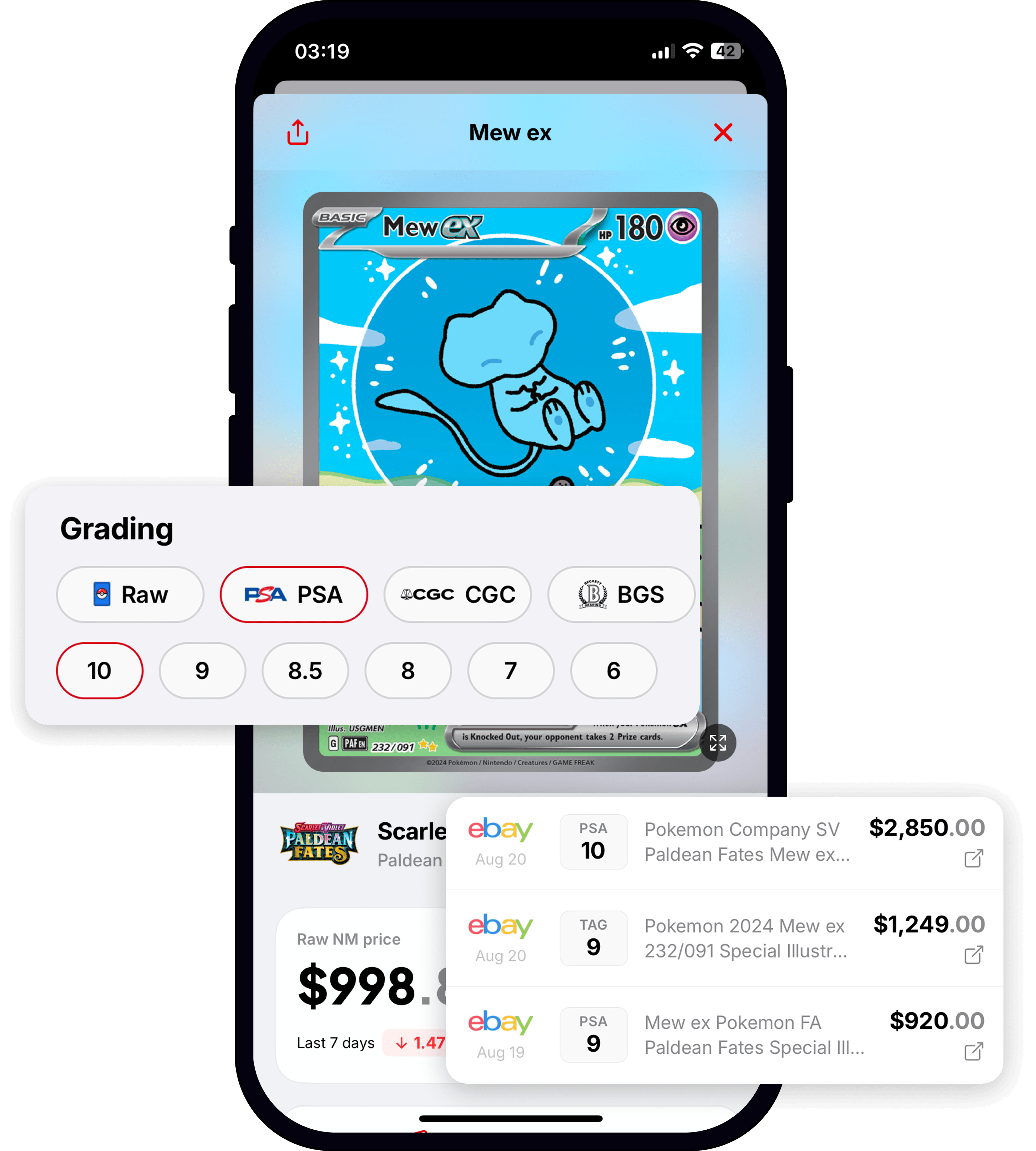
Comparing raw and graded? Cardex shows a card's raw price next to its PSA and CGC graded prices.
Get the free appWhat “raw” and “graded” prices actually mean
Raw means the card is ungraded. Its market value depends heavily on condition: a Near Mint copy and a played copy should not be priced from the same group of sales. Graded means a professional grading company has authenticated and assigned a numeric grade, then sealed the card in a holder.
The important distinction is that a graded price is tied to more than the card name. It is tied to the exact printing, the grading company, the numeric grade and the date of the sale. Do not treat a PSA 10, a PSA 9 and an ungraded copy as interchangeable reference points.
Compare prices in this order
- Match the card exactly. Confirm the Pokémon, set, collector number, language and variant. A reverse holo, promo, reprint or 1st Edition can have a very different market from a visually similar card. Use our set identification guide if you are unsure.
- Establish the raw baseline. Look at recent sales of ungraded copies with comparable condition. Ignore an active listing that merely asks for a high price.
- Find comparable graded sales. Match the same card to the same grading company and grade whenever possible. Compare more than one sale rather than anchoring on a single unusually high or low result.
- Check the condition honestly. Centering, corners, edges and surface all affect a grade. PSA’s published standards make clear that condition is assessed across these areas, and that small defects can change the result.
- Decide whether the possible premium covers your risk and costs. A price gap only helps if your card can plausibly achieve the grade you are comparing and the final sale value leaves room for grading, shipping, fees and time.
Use sold prices, not asking prices
Active listings show what a seller hopes to receive. Sold listings show what a buyer actually paid. When you review sales, filter out mismatches such as a different language, a bundle, a damaged copy, or the wrong grade. Our recent Pokémon card sales guide explains how to build a useful comparable-sales range.
Cardex makes that first pass quicker: scan the card to identify the printing, then compare its current raw and graded prices with recent eBay sale information and price history. It is still worth opening the closest matches and checking their details before you make a grading or selling decision.
Compare the right card, not a look-alike
Scan with Cardex to identify the exact card and review raw and graded prices, recent eBay sales and price history before you submit or sell.


Why the grade changes the price
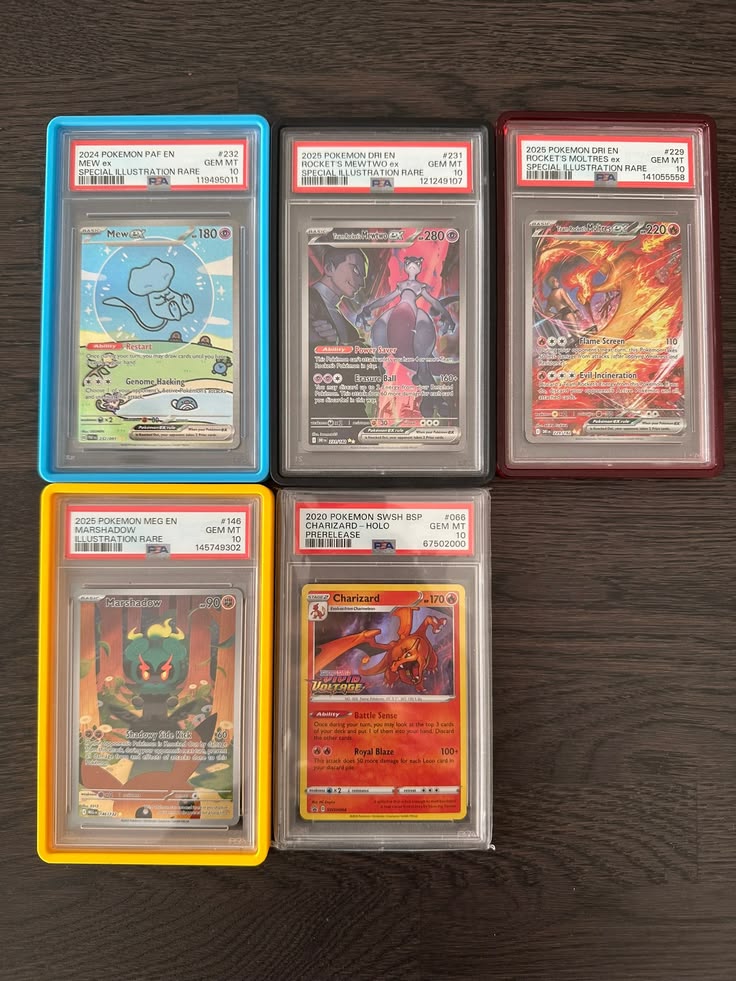
A grade summarizes the condition that a grader sees. PSA describes a Gem Mint 10 as virtually perfect and evaluates factors including centering, corners, edges and surface. That is why a top grade can command a much larger premium than a lower grade of the same card, but it also explains why a card that looks clean in a sleeve may not earn the grade a seller expects.
Before comparing your card with a top-grade sale, inspect it under good light. Look for whitening, edge chipping, scratches, print lines, dents, creases and uneven borders. Our Pokémon card condition guide explains what Near Mint, Lightly Played, Moderately Played, Heavily Played and Damaged mean in practical terms.
Do not mix these comparisons
| Do compare | Do not compare |
|---|---|
| The same set, number and variant | Different printings of the same Pokémon |
| Raw copies in similar condition | Near Mint raw copies against visibly played raw copies |
| The same grading company and numeric grade | Any “10” as though every label has the same market |
| Recent completed sales | High active-listing prices or old price-guide numbers |
| Single-card sales | Lots, bundles or listings that include extras |
When a graded premium is meaningful
A graded premium is meaningful when there are several comparable sales, the gap is consistent rather than driven by one outlier, and your card has a realistic path to that grade. It is less meaningful when only one sale exists, when the sales are old, or when the raw card has flaws that make the target grade unlikely.
This is why the answer to “Is my Pokémon card worth grading?” is different for every card. A rare vintage card may still be worth grading in a modest grade because scarcity matters. A modern card may need an exceptional grade for the numbers to work. The price comparison informs the decision; it does not guarantee the outcome.
A simple pre-submission checklist
- Exact set, number, language and variant confirmed
- Raw sales compared with the same condition in mind
- Recent graded sales matched by grader and grade
- Centering, corners, edges and surface inspected under light
- Grading, shipping, insurance and selling costs considered
- A lower-than-hoped-for grade would still make sense for you
Frequently asked questions
Are graded Pokémon cards always worth more?
No. Grading can add value, but the result depends on the exact card, its condition, the grade it receives and buyer demand. A lower grade may add little or may not cover the costs of submitting the card.
Should I compare a PSA 9 with a PSA 10?
Use both to understand the range, but do not assume your card will receive the higher grade. For a pricing estimate, compare sales at the grade your card can realistically reach and keep the grader and card version consistent.
How many sold listings should I check?
Check several recent, closely matching sales where they exist. A single sale can be an outlier because of timing, auction format, condition details or an incomplete listing title.
Sources and further reading
- eBay: Pricing your items: eBay’s guidance on using completed listings to research past sale prices.
- PSA: Grading Standards: published definitions and condition factors for PSA grades.
- PSA: Getting Started With Grading: an overview of the 10-point scale and the condition factors graders assess.