 Cardex

Working on a master set? Scan your cards into Cardex to keep a running list of what you own and what it is worth. See how it works.
Get the free appMaster set vs base set: the difference
Every Pokémon expansion has an official set size printed on the cards, say 244. But the expansion actually contains far more cards than that:
- Base set completion = one of each numbered card up to the printed set size (1–244).
- Master set completion = everything: the base cards, all secret rares numbered above the set size (245, 246, … often 100+ extra cards), and commonly all reverse holo variants too.
That's why a "244-card set" can be a 600+ card master set. It's a bigger, more expensive, and far more satisfying goal.
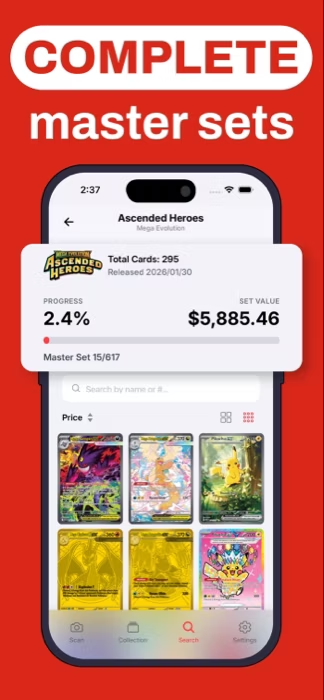
Step 1: Know what "complete" means for your set
Open the expansion in Cardex and you'll see the total card count including secret rares, the release date, and the current market value of the entire set. That last number matters: it tells you up front whether this master set is a $500 project or a $6,000 project, before you commit.
Step 2: Catalog what you already own
Scan your existing cards from that expansion. Each scan identifies the exact card and variant and checks it off. Your completion percentage and progress bar update as you go. No checklist printouts, no spreadsheet columns for reverse holos.
Start your master set tracker
Download Cardex free, pick your expansion and scan in your cards to begin tracking progress.


Step 3: Hunt the gaps intelligently
Once your owned cards are in, the set view shows what is missing, and current market data gives that list useful context:
- Sort the set by price. Buy the cheap singles in bulk lots early; they don't move much.
- Watch the expensive chase cards. Add the big Special Illustration Rares and Hyper Rares to your watchlist and wait for dips. Chase card prices often cool a few months after a set's release hype.
- Compare marketplaces per card. Cardex shows eBay, TCGplayer and Cardmarket side by side. For a 100-card shopping list, buying each card at the right marketplace adds up to real savings. (More in our marketplace guide, which works in both directions.)
- Singles beat packs for completion. Ripping packs is fun but statistically terrible for finishing a master set. Budget collectors buy singles; the packs are entertainment.
Step 4: Protect the value you're building
A master set is often the most valuable thing in a collector's binder, and the whole-set value shown in Cardex makes that concrete. Sleeve everything, follow a consistent binder organization system, keep the chase cards in top-loaders, and if a centerpiece card is pristine, check whether grading it makes sense (graded cards can anchor a master set's value).
How big is a master set? Real examples
The printed set size is only the start. Here is what the full checklist looks like for a few recent expansions, before counting reverse holos:
| Set | Printed size | Total with secret rares | With reverse holos |
|---|---|---|---|
| Surging Sparks | 191 | 252 | Roughly 440 |
| Prismatic Evolutions | 131 | 180 | Roughly 310 |
| 151 | 165 | 207 | Roughly 370 |
| Obsidian Flames | 197 | 230 | Roughly 420 |
| Paldean Fates | 91 | 245 | Roughly 330 |
Paldean Fates is the extreme case: 91 numbered cards and 154 secret rares, so the "small" set is one of the hardest to master. Cardex shows the full count for every expansion, so you know the real finish line before you start.
The cost curve: why the last 10 percent costs the most
Master set spending is not evenly spread. A typical modern set breaks down something like this:
- Commons, Uncommons and plain Rares (60 to 70 percent of the cards): a few cents each. Buy them as a bulk lot; a whole set's worth often costs less than one booster box.
- Reverse holos and Double Rares: $0.50 to $10 each. Still cheap individually, but there are a lot of them.
- Ultra Rares and Illustration Rares: $5 to $80 each. This is where the budget starts to matter.
- Special Illustration Rares and Hyper Rares (often fewer than 20 cards): $30 to several hundred each, and together they are usually more than half the total cost of the master set.
Plan for the last group from day one. Buy the cheap layers immediately, then buy the chase cards one at a time on dips instead of all at once at release prices.
A master set strategy that actually finishes
- Get the full checklist first. Open the expansion in Cardex to see every card, including secret rares and variants, and the current value of the whole set.
- Scan in what you own. Every scan checks a card off and updates your completion percentage.
- Sort the missing cards by price. Split them into "buy as a lot", "buy as singles" and "watch and wait".
- Buy the lot layer now. Sellers on eBay and TCGplayer offer near-complete common and uncommon lots for a few dollars.
- Trade your duplicates. Extra reverse holos from your own packs are the currency for other collectors' extras.
- Put the chase cards on the watchlist and buy when the price history shows a dip, which usually comes a few months after release.
- Protect the finished set. A completed master set is worth more sleeved and organized than loose; see how to store Pokémon cards.
Master set, complete set, playset: the terms
- Complete set or base set: one of each card up to the printed set size.
- Master set: every card in the expansion, including secret rares, and by most definitions every reverse holo variant.
- Playset: four copies of a card, the maximum allowed in a tournament deck. A playset collection is a competitive goal, not a collecting one.
- Binder set: an informal term for a complete set kept in a binder in number order.
Which set should you master?
For a first master set, pick an expansion that is still in print, that you genuinely like the artwork of, and whose chase cards are within your budget. In-print sets have cheap, plentiful singles; the cost is predictable and the hunt is fun rather than frustrating. Out-of-print sets like Evolving Skies or 151 are prestige projects: the last few alternate arts cost more than everything else combined, and prices only rise. Use the whole-set value in Cardex to compare candidates before you commit.
Master set FAQ
Do reverse holos count in a master set?
Most collectors say yes: one of each card plus its reverse holo variant. Some go further and include promo stamps. Define your own finish line; Cardex tracks the full variant list so the strictest definition is covered.
How much does a master set cost?
It varies enormously by set. The whole-set market value in Cardex gives you the real-time answer for any expansion, and it's usually dominated by a handful of chase cards.
Is a completed master set worth more than its parts?
Complete sets are easier to sell as a showcase lot and often attract premium buyers, but value is still driven by the key cards and their condition.
Do promo cards count in a master set?
Usually not. Promos have their own numbering and are collected separately. Some collectors include the promos released alongside a set, such as the Elite Trainer Box promo, as a bonus.
Should I include Japanese versions?
No. Japanese sets are different products with different card lists and numbering. A master set is completed in one language.
How long does a master set take?
For an in-print set bought mostly as singles, a few weeks to a few months depending on budget. For an out-of-print set, often years, because the last chase cards appear rarely and cost the most.