 Cardex

Before you list, scan the card with Cardex to compare eBay, TCGplayer and Cardmarket prices side by side. See how it works.
Get the free appThe three marketplaces at a glance
| Marketplace | Useful when | What to check first | Region |
|---|---|---|---|
| TCGplayer | US-facing singles | Seller type, commission, processing and Direct fees | US |
| eBay | Listings where photos and item-specific detail matter | Category, listing format, seller account and final-value fees | Global |
| Cardmarket | European buyers and EUR listings | Current seller terms, payment options and shipping requirements | Europe |
Marketplace costs and policies change. Check the current schedule and seller requirements for your exact account and listing before you set a price.
First: find out what your card actually sells for on each
Before choosing where to sell, you need three numbers, not one. Scan the card with Cardex and you get exactly that on a single screen:
- eBay: review recent sale information for your exact card.
- TCGplayer: Low / Mid / Market / High pricing for the exact variant and finish.
- Cardmarket: EUR pricing and price-history context.
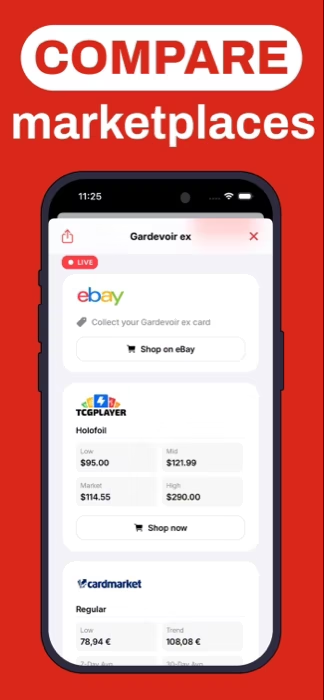
Check all three marketplaces in one scan
Download Cardex free and see what your card is really selling for on eBay, TCGplayer and Cardmarket before you list it.


Which marketplace for which card?
Sell on TCGplayer when…
You are selling to US-based buyers and the card has enough comparable listings for you to price it carefully. Before listing, check the seller programme and fees that apply to your account.
Sell on eBay when…
Your listing benefits from detailed photos, a clear condition description or an auction/fixed-price choice. Compare recent completed sales for the exact card, variant and grade before deciding on a format.
Sell on Cardmarket when…
You are selling to European buyers in EUR. Read Cardmarket's current condition definitions, shipping expectations and seller terms before listing; use the marketplace's own condition language consistently.
Timing: don't sell into a falling chart
Card prices swing with set releases, tournament results and social media hype. Before listing, review the card's price history and recent eBay sales in Cardex:
- Price rising? Check whether the recent sales volume supports the move before treating it as a new baseline.
- Price falling? Compare several recent sales rather than anchoring to an older high sale.
- Not sure? Use a watchlist to follow the data while you decide.
Fees and payouts compared
Fees decide how much of the sale price you keep, and they differ more than most sellers realize. Approximate figures for a single trading card sale in 2026; check the current schedule for your account before listing:
| Marketplace | Approximate fees | Payout | Best for |
|---|---|---|---|
| eBay | Around 13 percent of the total including shipping, plus a small fixed fee per order | Bank transfer after the buyer pays; funds can be held for new sellers | Graded cards, high-value singles, anything that needs photos |
| TCGplayer | Around 10 percent marketplace commission plus a payment processing fee | Regular payouts; Direct program handles fulfillment for a further cut | Raw modern singles to US buyers at scale |
| Cardmarket | Around 5 percent commission plus payment fees, the lowest of the three | EUR, paid out to a bank account | European buyers, raw singles in EUR |
The practical result: a $100 raw card nets roughly $85 on eBay, $87 on TCGplayer and about $93 on Cardmarket before shipping. For graded and high-value cards, eBay's larger buyer pool usually outweighs its higher fee.
Other places to sell Pokémon cards
| Option | Pros | Cons |
|---|---|---|
| Local card shop | Cash the same day, no shipping, no fees, good for bulk | Expect 30 to 60 percent of market value on singles and a few dollars per thousand for bulk |
| Card shows and conventions | Many buyers in one room, negotiation, trades | Table costs, travel, need to price everything in advance |
| Facebook groups and Discord | No fees, motivated collectors, easy lots | Scam risk both ways; use tracked shipping and goods-and-services payment |
| Reddit (r/pkmntcgtrades) | Reputation system, active buyers | Rules are strict; read them first |
| Live selling apps (Whatnot and similar) | Fast sales, entertainment value, good for volume | Prices can undershoot for singles, fees comparable to eBay |
| Buylist services | Simple: ship a list, get paid | Lowest payouts of all options |
Singles, lots or the whole collection?
- Sell valuable cards as singles. Anything worth more than about $10 to $15 is worth listing individually; that is where you capture full market value.
- Sell mid-value cards as themed lots. A "20 holo rares from Surging Sparks" lot sells faster than 20 separate $3 listings and costs less in fees and shipping.
- Sell bulk by weight or count. Commons and Uncommons go by the thousand to shops or bulk buyers. Do not list them individually.
- Selling everything at once? Expect a buyer to pay 50 to 70 percent of the tracked market value for a whole collection, in exchange for you not doing any of the work. Scan the collection into the tracker first so both sides negotiate from real numbers.
Shipping and payment without getting burned
- Sleeve every card and use a toploader or semi-rigid holder for anything over a few dollars. A card that arrives damaged is a refund and negative feedback.
- Under about $20: a plain envelope with the card in a sleeve and toploader is standard; eBay's Standard Envelope service adds tracking cheaply for cards in the US.
- Over about $20: bubble mailer with tracking. Over a few hundred, add insurance and signature.
- Off-platform sales: accept only payment methods with buyer and seller protection, and never ship before payment clears. If a buyer insists on friends-and-family payment, walk away.
- Photograph the card before packing, front and back, so you have proof of condition if a dispute comes up.
Photos that sell cards
On eBay and in groups, the photo is the listing. Shoot on a plain dark background in daylight or under a soft lamp, straight on, with the card out of the sleeve for the main photo and in the sleeve for a second one. Add close-ups of every corner and a tilted shot of the holo to show scratches or their absence. Buyers pay more for a card they can inspect than for one they have to trust.
Questions about selling Pokémon cards
Where can I sell Pokémon cards for cash near me?
Local card and game shops buy singles and bulk for cash or store credit, and card shows are the best place to sell to many buyers at once. Expect below-market offers in exchange for the convenience.
Is it better to sell on eBay or TCGplayer?
TCGplayer for raw modern singles to US buyers, eBay for graded, vintage and high-value cards and for anything outside the US. Check what your exact card sells for on each before deciding; Cardex shows both.
How much do card shops pay for Pokémon cards?
Typically 30 to 60 percent of market value for singles they can resell, more for cards in high demand, and a few dollars per thousand for unsorted bulk.
Should I sell my whole collection as one lot?
Only if speed matters more than money. Pulling out the valuable singles first and selling the rest as a lot usually nets far more than selling everything together.
Before you list: a 4-point checklist
- Confirm the exact card: set, number, variant. (One scan; misidentified listings sell at the wrong price. See identifying your card's set.)
- Be honest about condition: Near Mint claims on played cards earn returns and bad feedback.
- Check if grading pays first: for valuable near-mint cards, compare realistic raw and graded sales before you submit. See is my card worth grading? and how to compare raw versus graded prices.
- Price against current comparables: use recent sales for the exact card, condition, variant and grade rather than an old sale for a similar card. Our Pokémon card eBay pricing guide walks through the process.