 Cardex
Work in order: cheap checks first, destructive checks never
The mistake most people make is starting with the rip test or the light test they saw in a video. Those come last, and the rip test destroys the card. Almost every counterfeit in circulation gives itself away earlier than that, on details the printer could not afford to get right.
| What to check | Genuine card | Common counterfeit tell |
|---|---|---|
| Card back | Deep, consistent blue; crisp swirl; sharp Poké Ball edges | Blue looks purple, washed out or too dark; blurry swirl; soft edges |
| Text and fonts | Tight, even letter spacing in the correct typeface | Wide or uneven kerning, wrong font weight, misspellings |
| The word "Pokémon" | Acute accent on the "e", everywhere including the copyright line | Missing accent, or "Pokemon" in the fine print |
| Print quality | Sharp under magnification; solid colour fields | Visible dot pattern, fuzzy borders, dull ink |
| Card stock | Firm, slight snap, consistent thickness | Papery and flimsy, slick and plasticky, or unusually thick |
| Texture on chase cards | Physically embossed, you can feel the pattern | Flat card with the texture printed onto it |
| Energy and set symbols | Correctly shaped, sized and aligned | Misshapen, off-centre, wrong size, or missing |
| Card data | Set, number, rarity, HP and attacks match the real printing | Inflated HP, impossible evolution, number not in that set |
1. Start with the back of the card
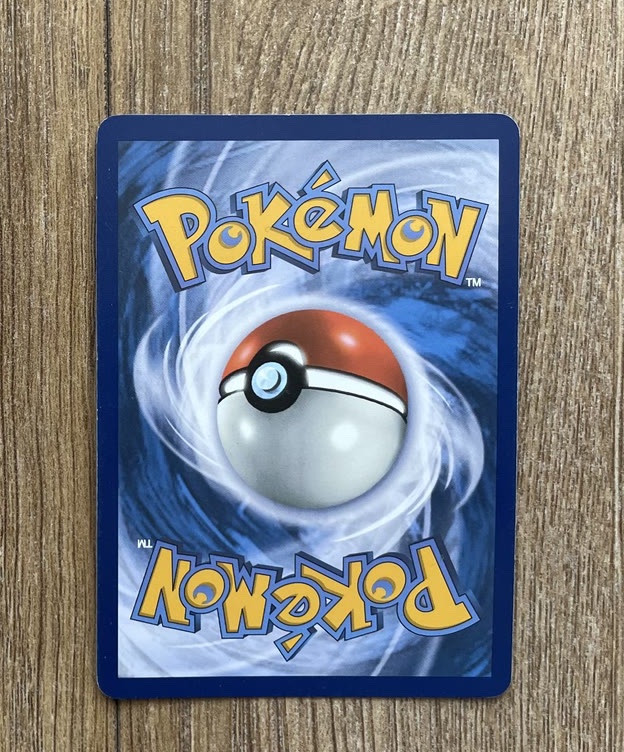
The back is the single most useful check because it is identical across an entire era of cards, so you always have something to compare against. Pull any card you trust out of a binder, lay the two side by side under good light, and look at three things: the blue, the swirl and the edges.
Counterfeit printers rarely match the blue. It usually drifts purple, grey or noticeably lighter than the real card. The white swirl behind the Poké Ball loses definition and turns into a smudge. The border between the dark blue frame and the artwork goes soft instead of staying crisp. Any one of those on its own can be a lighting trick; all three together is a fake.
Also check the centring of the back. Genuine cards are not perfectly centred either — that is exactly why card condition matters for grading — but a back that is dramatically off, with a fat border on one side and almost none on the other, is worth a second look alongside the other checks here.
2. Read the text closely — kerning gives fakes away
Fonts are the hardest thing for a counterfeiter to fake, because they have to rebuild the layout rather than copy it. The result is text that is almost right. Letter spacing runs wide and inconsistent, the weight of the font is slightly too heavy or too thin, and the attack text sits a little too far left or right in its box.
Read the actual words too. Misspellings in attack names, flavour text and ability descriptions are common on fakes, and so is a missing acute accent on the "é" in Pokémon — particularly down in the copyright line at the bottom of the card, where counterfeiters assume nobody is looking. The community reference guide maintained at JustInBasil documents this pattern in detail across many known counterfeits.
3. Look at the print quality under magnification
Genuine cards are printed on commercial presses. Most fakes are scans reproduced on a consumer printer, and that difference becomes obvious the moment you magnify the card. Use your phone's camera zoom or a cheap jeweller's loupe and look at a solid colour area and a border edge.
On a fake you will often see a coarse dot pattern where the real card has smooth colour, and edges that look pixelated rather than cut. Grading companies rely on exactly this: CGC's published counterfeit card alerts repeatedly point to duller colours, wrong holo patterns and print quality that collapses under magnification.
4. Feel the card before you look at it again
Handling tells you things your eyes miss. A genuine card is firm with a slight snap and a consistent thickness from edge to edge. Fakes tend to fail in one of two directions: papery and flimsy, or slick and plasticky. A third variant exists where a fake front has been glued onto a real modern card, which makes the result almost twice as thick as it should be — noticeable immediately when you stack it against a real card.
Size matters as well. Counterfeits are frequently a fraction smaller than a real card. Line up your suspect card and a real one, square up two edges, and see whether the other two edges match.
5. Check the texture on chase cards with your fingers
Modern Illustration Rares, Special Illustration Rares and other high-end cards have genuine embossed texture you can feel — raised lines in the artwork, the frame or the background pattern. This is expensive to reproduce, so counterfeiters skip it.
Watch for the giveaway version of this: a flat card with the texture printed on it. It looks textured in a photo, which is enough to sell a card online, but your fingertip finds a completely smooth surface. If a card is supposed to be a Special Illustration Rare and feels like a normal card, it is not what the seller says it is. Our guide to rarity symbols covers which modern rarities should carry texture in the first place.
6. Check the energy symbols, HP and attacks
Energy symbols are small, precise and repeated many times across a card, which makes them a reliable weak point. On fakes they turn up misshapen, the wrong size, misaligned inside their circles, or simply missing from an attack cost.
Then read the card as a card. Counterfeits sold as novelties or in bulk lots frequently carry absurd stats — a Basic Pokémon with 300 HP, an attack that does 500 damage, an evolution chain that does not exist in the games. Anything that would obviously break the actual trading card game is not a real tournament-legal card.
7. Check the card against real set data
This is where the physical inspection meets the paperwork. Every genuine card belongs to a specific set, has a specific collector number, a specific rarity and specific printed text. If the card in your hand claims to be number 145/102 in a set that ends at 102, or shows a rarity that set never printed, you are done — no further inspection needed.
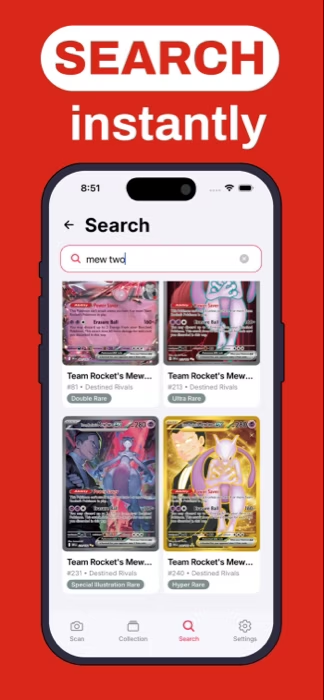
Scanning the card is the fastest way to pull up what the real printing should look like. Cardex identifies the card and shows its set, collector number, rarity and current market price, so you can compare the genuine reference against the object in your hand.
8. Leave the light test and rip test until last
Genuine cards are built in layers with an opaque core, so holding one to a bright light blocks most of it while a thin fake glows through. This is a genuinely useful hint, and it costs you nothing. It is also not proof: card stock has changed across eras, and better counterfeits now use layered stock specifically to survive this test. Treat it as one more signal, not a verdict.
The rip test — tearing a card to look for the dark inner layer — does work, and it also permanently destroys the card. Only ever run it on a card you have already written off, and never on something you might return, sell or grade. If a card is valuable enough that you genuinely cannot decide, submitting it to a grading company is the version of this test that leaves you with a card at the end. Our guide on whether a card is worth grading covers when that cost makes sense.
Look up the real card details
Scan any card with Cardex to see its exact set, collector number, rarity and live market price from eBay, TCGplayer and Cardmarket — the reference you need before deciding what is in your hand.


Where fakes usually come from
Counterfeits cluster in predictable places, and avoiding them is mostly about avoiding those places. Large "mystery" lots at a price no real lot could support, resealed booster packs, third-party marketplace sellers with no card-specific history, and bulk imports advertised with stock photos instead of the actual card are all high-risk.
- Price that is too good. A card that sells for $200 everywhere is not available for $12 from a new seller. Check the real market price before you buy, not after.
- Stock photos. If the listing does not show the actual card, front and back, in the seller's own photos, you cannot run any of the checks above before paying.
- Resealed packs and "repacks". Sealed product is the easiest thing to tamper with and the hardest to verify. Buy sealed product from established retailers.
- Graded slabs from unknown sellers. Slabs get counterfeited too. Verify the certification number on the grading company's own site before you pay.
Before buying anything expensive, check what the card actually trades for. Our guide on how much a Pokémon card is worth walks through reading market prices properly, and where to sell Pokémon cards covers which marketplaces have the strongest buyer protection.
What to do if you already bought fakes
Document before you act. Photograph the card front and back, screenshot the listing including the seller name and price, and keep the packaging it arrived in. Marketplaces resolve disputes on evidence, and listings get deleted.
Then open a return or a dispute with the marketplace inside its claim window — eBay, TCGplayer and Cardmarket all run buyer protection programmes, and counterfeit goods are one of the clearest cases they handle. Counterfeit product can also be reported through Pokémon Support. One thing to avoid entirely: do not resell cards you believe are fake, even labelled as "proxies" or "custom" — that is how they re-enter circulation.
Frequently asked questions
What is the fastest way to tell if a Pokémon card is fake?
Put the card next to a card you know is genuine from a similar era and compare the backs. Counterfeits very often get the blue tone, the swirl pattern and the sharpness of the Poké Ball artwork slightly wrong, and that difference is visible in a couple of seconds once you have a real card beside it.
Does the light test work on Pokémon cards?
Holding a card up to a bright light can be a useful hint, because genuine cards have an opaque inner layer that blocks most light. It is not proof on its own. Some counterfeits now use a similar layered stock, and card thickness varies between eras, so treat the light test as one signal among several rather than a verdict.
Should I do the rip test to check a Pokémon card?
Only on a card you are willing to destroy. Tearing a genuine card reveals a dark grey or black inner layer, but it also permanently ruins the card. Use non-destructive checks first, and never rip a card you might sell, grade or return.
Can a scanner app tell me if a Pokémon card is fake?
No card scanner authenticates a card. A scanner identifies the printing it thinks it is looking at and shows the market price. That is still useful for spotting fakes indirectly: if the card in your hand does not match the real card's set, number, rarity, HP or attack text, something is wrong. Physical inspection is still what decides authenticity.
What should I do if I bought fake Pokémon cards?
Stop and document first: photograph the card, the listing and the packaging before contacting anyone. Open a return or dispute with the marketplace you bought from within its claim window, and report counterfeit product to Pokémon Support. Do not resell cards you believe are counterfeit.