 Cardex
Why track your collection at all?
- You'll know what it's worth. Collections quietly grow into real money, and many collectors are shocked the first time they see the total.
- You'll stop buying doubles. A tracked collection lets you check whether you already own a card.
- You'll sell at the right time. Prices move; a portfolio chart shows you when your cards spike.
- Insurance and trades get easier. A documented collection with market values beats "a binder of cards, trust me."
The old way vs the scan way
The traditional method is a spreadsheet: type each card's name, look up its set and number, find a price, paste it in, repeat 400 times, then watch every price go stale within a month. A collection tracker app replaces all of it:
- Start automatic scanning with the Cardex camera scanner. Each card is identified by set, number, rarity and variant as you work through the stack.
- Tap to add it to your collection or a specific binder.
- Prices update themselves. Your total portfolio value is always based on live market prices, not the numbers from the day you cataloged.
Catalog your first binder tonight
Download Cardex free and scan through a stack to build a collection record without manually searching every card.


What a good Pokémon collection tracker gives you
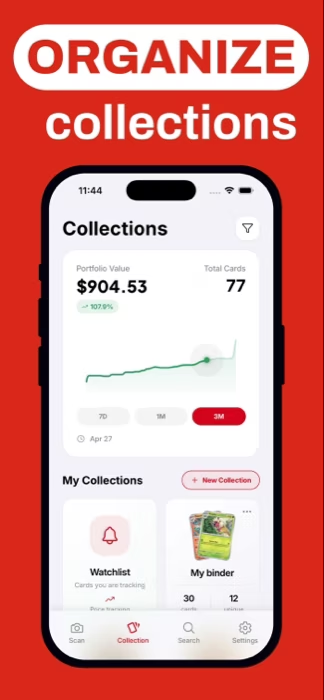
Portfolio value with history
Cardex charts your collection's total value over time, so you can follow its price history instead of relying on the numbers from the day you cataloged it.
Binders: organize your way
Create custom binders (by set, by Pokémon, by "cards to sell", by kid-vs-parent collection) and see counts, unique cards and value per binder. If your physical collection is still a pile, start with these five practical binder systems.
A watchlist for cards you don't own yet
Add chase cards to the watchlist and track their prices without owning them. When the price of a card you want dips, you'll be the one who notices.
Sealed products next to your cards
Booster boxes, Elite Trainer Boxes and other sealed products go into their own collections in Cardex, with prices and price history, and their value counts toward your portfolio total.
Per-card price trends
Every card in your collection links to raw and graded price data, recent eBay sales and marketplace information from eBay, TCGplayer and Cardmarket, useful the day you decide to sell.
A practical workflow for cataloging a big collection
- Sort out the obvious bulk first. Commons and uncommons with plain symbols (see rarity symbols) can be scanned in batches later. Start with holos, ex's and full arts.
- Scan the good stack. Start automatic scanning, then add each identified card to the right binder as you go.
- Flag surprises. Anything that scans higher than expected goes in a "review" binder, then check whether it's worth grading.
- Set up your watchlist. Add the cards you're hunting so prices come to you.
- Check the portfolio chart weekly. That's it. The tracker maintains itself because prices are live.
Spreadsheet or app? An honest comparison
| Spreadsheet | Collection tracker app | |
|---|---|---|
| Adding a card | Type name, look up set and number, find a price, paste it | Scan it; set, number, variant and price are filled in |
| Prices | Frozen at the day you entered them | Update automatically from live market data |
| Variants | You have to know and note holo, reverse holo, 1st Edition | Identified by the scanner |
| Total value | A formula you maintain | Always current, with history |
| Flexibility | Any column you like, including purchase price and notes | Fixed fields, but binders and watchlists cover most needs |
| Portability | Yours forever, exportable | Lives in the app; export options vary |
Spreadsheets still win for people who want purchase-price accounting or unusual fields. For everyone else, the time saved on entry and the live prices make an app the practical choice. Many collectors use both: the app for the running collection and a spreadsheet for cost basis on expensive cards.
What to record for every card
- Set and collector number. The identity of the card. Without these a price is a guess.
- Variant. Holo, reverse holo, 1st Edition, promo stamp. Same number, different price.
- Condition. NM, LP, MP or HP. Most trackers value cards at the near-mint price by default; if half your collection is played, the total is optimistic unless you mark it. Cardex lets you set condition per card.
- Quantity. Three copies of a card is three times the value and a reason to trade the extras.
- Where it is. Which binder or box, so you can find it when someone wants to buy it.
- What you paid, for valuable cards. Not needed for bulk, but for anything over $20 it tells you whether a sale is a gain or a loss.
How a collection's value is actually calculated
A tracker adds up a market price for each card multiplied by quantity. Three details decide whether that number means anything:
- Which price. Cardex uses current market data from eBay, TCGplayer and Cardmarket rather than a single listing, and shows raw and graded prices separately. A raw card in a tracker should be valued at the raw price, not at a PSA 10 sale.
- Which condition. Near mint is the default assumption. Mark played cards as such or mentally discount the total.
- What you could actually sell for. Market value is not cash in hand. After marketplace fees and the discount buyers expect on lots, a collection usually sells for well under its tracked value. Treat the total as a scoreboard, and use recent sales when you price a real transaction.
Tracking for insurance, trades and resale
A documented collection with current market values has uses beyond curiosity. For home insurance, a dated list with values is what an adjuster asks for after a loss; without it, a binder is "some cards". For trades, both sides can see the same numbers, which takes most of the argument out of a swap. And when you decide to sell a lot, the tracker export is your sales sheet: buyers pay more for a lot they can evaluate card by card than for a mystery box.
Photograph your most valuable cards front and back as well. The tracker proves what you own; the photos prove the condition.
Keeping the tracker accurate over time
- Add cards when they arrive, not once a month. A backlog is how tracking dies.
- Remove cards when you sell or trade them. A tracker that still counts sold cards is quietly lying to you.
- Review condition when you move a card. Cards get played and handled; a card marked NM in 2024 may be LP now.
- Check for duplicates before buying. This is the single biggest saving most collectors get from tracking.
- Look at the value chart, not just the total. A total tells you where you are; the chart tells you which way you are going and which cards moved it.
Collection tracker questions
Is there a free app to track Pokémon cards?
Yes. Cardex is free to download on iPhone, iPad and Android, and you can scan cards into your collection and see its value right away. Your first 3 scans are free; unlimited scanning, graded prices and the full list of recent eBay sales come with Cardex Premium (weekly, yearly or lifetime plans, with a free trial).
Can I track cards I do not own yet?
Yes. Add them to the watchlist. Their prices are tracked without counting toward your collection value, which is useful for chase cards and master set gaps.
Does the tracker work for Japanese cards?
Yes. Japanese cards are identified and priced separately from English printings, so a mixed collection is valued correctly.
How often do collection values update?
Continuously, as market data updates. You do not need to re-enter anything; open the app and the total reflects current prices.