 Cardex
Start with the marketplace, not your best guess
Card condition is not one universal grade. TCGplayer lets sellers list cards as Near Mint, Lightly Played, Moderately Played, Heavily Played or Damaged. Cardmarket uses a different sequence that includes Mint, Near Mint, Excellent, Good, Light Played, Played and Poor. A card called LP on one platform does not automatically map to the same label on another.
That matters when you compare prices. If you plan to sell on TCGplayer, use TCGplayer's current standard. If you plan to sell on Cardmarket, use Cardmarket's. When a card sits between two categories, choosing the lower condition is usually the safer listing decision.
Pokémon card condition chart
The descriptions below are a practical summary of the five categories used by TCGplayer. They are not a replacement for the marketplace's complete standards, which include detailed limits for different imperfections.
| Condition | What you may see | What you should not ignore |
|---|---|---|
| Near Mint (NM) | Nearly unplayed appearance, crisp corners and only a few minimal imperfections | Obvious surface wear, a crease or major edge damage |
| Lightly Played (LP) | Minor edge wear, small scuffs or light scratches without structural problems | Several severe flaws or damage that changes the card's integrity |
| Moderately Played (MP) | Noticeable edge or surface wear, scratches, scuffing and some bends or creases | Damage severe enough to compromise the card |
| Heavily Played (HP) | Major whitening, scratches, bends or wear across multiple areas | Missing material, severe liquid damage or lost structural integrity |
| Damaged | Serious defects such as tears, punctures, major faults or structural damage | Do not hide the defect; photograph and describe it clearly |
A single flaw can cap the condition even when the rest of the card looks clean. For example, TCGplayer's current standard says a crease places a card at Moderately Played at best, while a bend that affects structural integrity is Damaged. This is why averaging the front and back does not work. A clean front cannot cancel worn or damaged cardstock on the back.
What do NM, LP, MP and HP mean on Pokémon cards?
The letters you see in listings are shorthand for the condition categories above. NM is Near Mint, LP is Lightly Played, MP is Moderately Played, HP is Heavily Played and DMG is Damaged. The one that confuses people most is HP: on the card itself HP means hit points (the number next to the Pokémon's name), but in a listing title or a price list HP means Heavily Played. Context tells you which one is meant. If a seller writes "Charizard 120 HP, condition HP", the first is the game stat and the second is the wear grade.
As a rule of thumb, an LP copy sells for roughly 70 to 85 percent of the NM price, an MP copy for 50 to 70 percent and an HP copy for 30 to 50 percent. For a full breakdown of every abbreviation, including the different names Cardmarket and eBay use, see Pokémon card condition abbreviations explained.
How to check a Pokémon card's condition
1. Remove the sleeve and use angled light
A sleeve can hide scratches, dents and clouding. Wash and dry your hands, clear a clean surface, then hold the card by its edges. Look at it straight on and tilt it under a bright light. Angled light reveals holo scratches and surface impressions that disappear in a flat photograph.
Do not scrub the card, use chemicals or try to press out a crease. Cleaning or altering a collectible can create new damage and may make professional authentication more difficult. For a low-risk approach to dust, fingerprints and dirty sleeves, see our Pokémon card cleaning guide.
2. Check the front surface
Move the light across the artwork and holo area. Look for scratches, scuffs, print lines, dents, stains, peeling and loss of gloss. Fingerprints can be visible without changing the cardstock, but do not assume every mark can be safely removed.
Foil cards need extra attention because scratches and clouding can hide until the angle changes. Factory defects also count under some marketplace standards, even if the card went straight from a pack into a sleeve.
3. Inspect all four corners and edges
Turn the card over and look for white spots where the colored surface has worn away. One tiny point of whitening is different from a long rough edge. Check whether the corners are sharp, frayed, bent or separating. Then view the card edge-on to spot dents and bends.
4. Examine the back carefully
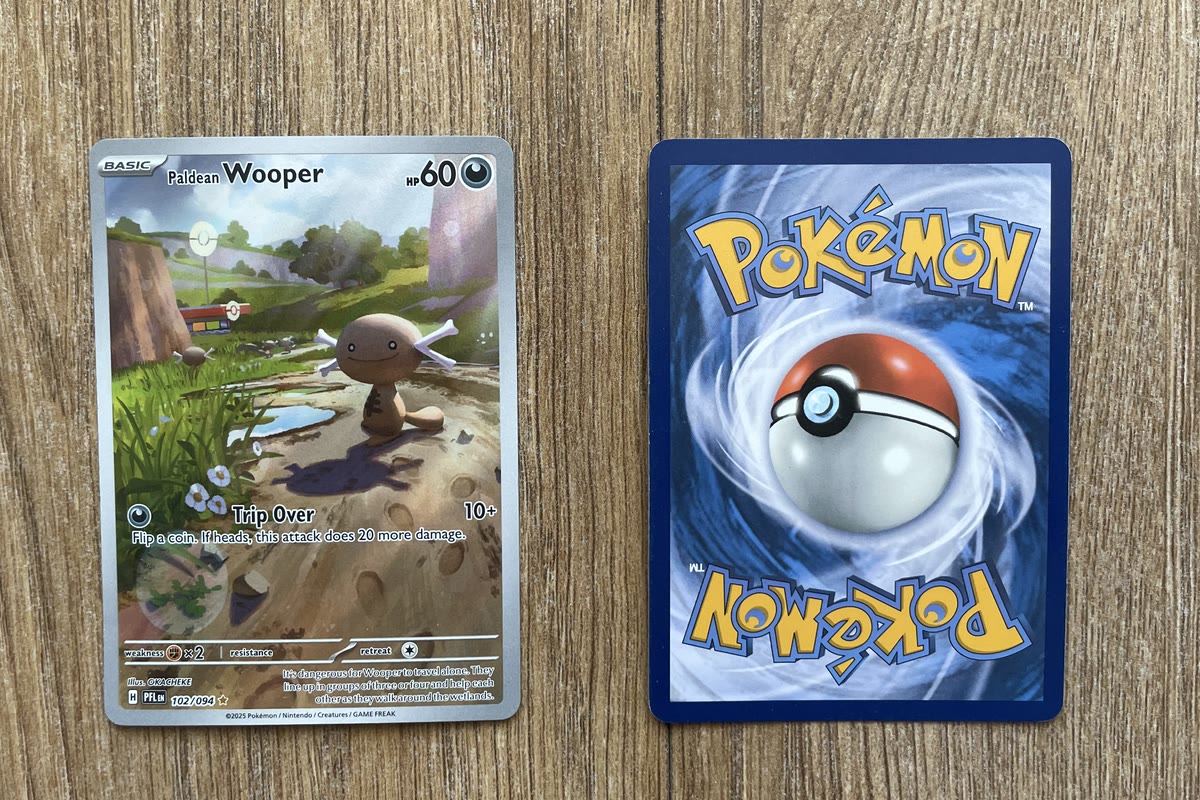
The dark blue border on many English Pokémon card backs makes whitening easy to see. Do not let clean artwork on the front distract you from worn corners on the back. Buyers will judge the whole card.
The back is also where authenticity problems show up first. If the blue looks washed out or purple, or the swirl pattern behind the Poké Ball is blurry compared to another card from the same era, stop grading and check the card properly — our guide on how to tell if a Pokémon card is fake covers what to look for.
5. Look for structural problems
Creases, folds, peeling layers, liquid exposure, tears and punctures matter more than a few light surface marks. Check whether the card lies naturally flat and whether any flaw passes through the cardstock. If the structure is compromised, a high condition label is not appropriate.
6. Treat centering as a separate question
Centering is important for professional numerical grades, but it is not the same thing as wear. A clean, off-center card may still fit a raw marketplace's Near Mint condition while having a lower chance at a top professional grade. PSA, for example, evaluates centering alongside corners, edges and surface.
How condition affects Pokémon card value
Cleaner copies usually sell for more, but there is no reliable rule such as "LP is always worth 70% of NM." The discount depends on the exact card, the severity of the flaw, available supply and what buyers will accept.
A modern card with many clean copies available may receive a steep discount for visible damage. A scarce vintage card can still be valuable in a lower condition because buyers have fewer alternatives. The only useful comparison is the same card, from the same set, in the same variant and a similar condition.
A practical pricing workflow
- Identify the exact card. Confirm the name, set, collector number, language and variant. Our set identification guide explains what to check.
- Inspect the physical copy. Use the front, back, corners, edges and structure, not one flattering photo.
- Choose a conservative condition. Read the marketplace's complete standard if the card is close to a boundary.
- Compare like with like. Check recent listings or sales for the identical printing in the same condition.
- Show the flaws. For a valuable card, include clear front, back and close-up photos so the buyer can judge it too.
Start with the correct card and market
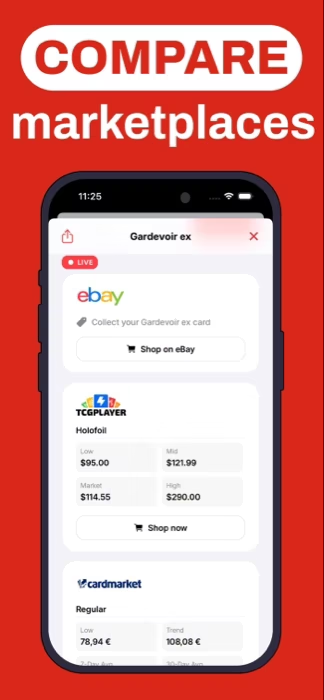
Scan the card in Cardex to identify its set and variant, then compare eBay, TCGplayer and Cardmarket pricing before adjusting for your copy's condition.


Common condition mistakes
- Calling a pack-fresh card Mint. Cards can leave a pack with print lines, rough edges, dents or poor centering. TCGplayer does not use Mint or Gem Mint as a listing condition.
- Inspecting through a sleeve. The sleeve's own scratches can hide or imitate damage.
- Judging only the front. Back-edge whitening is one of the easiest flaws to miss in a binder.
- Using one price for every condition. A Near Mint market estimate is not automatically the value of an MP copy.
- Confusing raw condition with a PSA grade. Marketplace labels and professional grading scales answer different questions.
- Listing optimistically. A generous condition label may create a return or dispute. Clear photos and a conservative category protect both sides.
Condition check before grading
If you are considering professional grading, repeat the inspection with stricter standards. Focus on centering, corners, edges and surface, then compare the raw value with realistic graded sales rather than the best possible result. A card can be worth keeping or selling raw even when it is unlikely to earn a top grade.
Use our Pokémon card grading guide to compare the possible premium with all submission costs and the risk of receiving a lower grade. For the comparison itself, see how to read raw versus graded card prices. Until you decide, use a suitable sleeve and holder rather than repeatedly handling the card; our Pokémon card storage guide explains the practical options. Cardex can show raw and graded price data, recent eBay sales and price history, but it does not predict or guarantee a professional grade.
Frequently asked questions
What does Near Mint mean for a Pokémon card?
Near Mint means the card looks nearly unplayed. It may have a few minimal imperfections, but it should not have obvious surface wear, heavy whitening, a crease or structural damage. Check the marketplace's exact rules before listing.
Does whitening make a Pokémon card Lightly Played?
A small amount of visible edge or corner wear may place a card in Lightly Played condition, but the category depends on the combined number and severity of all imperfections. Heavy or widespread whitening can push it lower.
Is a creased Pokémon card considered damaged?
Not automatically on every marketplace. TCGplayer's published standards allow some creases at Moderately Played or lower depending on severity. A bend that compromises the card's structural integrity is Damaged. Use the marketplace's current definitions rather than guessing.
Can an app determine a Pokémon card's condition?
An app can identify the exact card and show relevant market prices, but subtle scratches, dents, whitening and creases still need a physical inspection. Cardex does not assign a condition grade or guarantee a professional grading result.
How does condition affect Pokémon card value?
Buyers generally pay more for cleaner copies, but there is no universal multiplier. Compare recent prices or sold listings for the exact card, variant and condition. If you are starting from scratch, our guide to checking a Pokémon card's value covers the other factors that matter.
Condition standards referenced
Marketplace definitions can change. For a card you plan to list or submit, read the current primary standard: