 Cardex
Quick answer: look at the bottom corner of the card. The collector number (081/244) tells you the card's position in the set, the small set symbol or three-letter set code (SVI, PAF, MEG) tells you which expansion, and the copyright year narrows the era. No set symbol at all usually means Base Set from 1999. Or scan the card and let the app read all of it.

Faster than reading the corner: scan the card with Cardex and it shows the set, number and rarity for you. See how the scanner works.
Get the free appThe instant way: scan the card
Identifying cards by eye means learning hundreds of set symbols spanning 25+ years. A card scanner skips all of that:
- Open Cardex and tap Scan.
- Point the camera at the card, front side, any orientation.
- Cardex identifies the exact card: name, set, collector number, rarity and variant, and shows its live market price on the same screen.
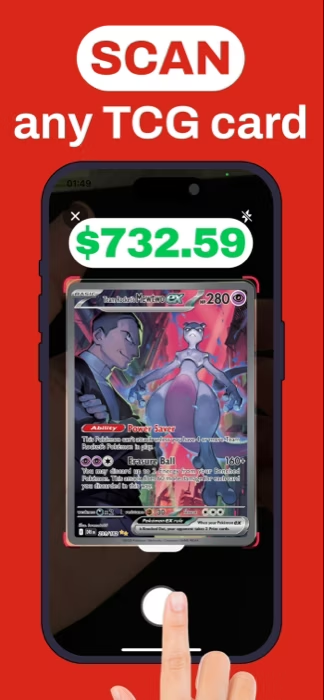
This matters because the same artwork is often reprinted across sets, and each printing has a different value. Guessing wrong means pricing wrong.
Identify cards as you scan
Free to download. Start automatic scanning to get the set, number, rarity and current price data for your mystery cards.


The manual way: reading the card
1. Find the collector number
Look at the bottom left or bottom right corner. Modern cards show a number like 081/244: this card is number 81 in a 244-card set. If the first number is bigger than the second (for example 250/244), you're holding a secret rare. Check its value before doing anything else.
Some subsets use their own numbering. Trainer Gallery cards from the Sword & Shield era read TG12/TG30, Galarian Gallery cards from Crown Zenith read GG45/GG70, and promo cards carry a promo prefix such as SWSH001 or SVP 044 instead of a set fraction.
2. Find the set symbol or set code
Next to or near the collector number there's a small set symbol (an icon unique to each expansion) and, on cards from 2020 onward, a three-letter set code in a small box. Vintage Wizards of the Coast cards from Base Set famously have no set symbol at all.
3. Check the copyright line and language
The fine print at the bottom shows the copyright year range, which narrows down the era. A line that ends in 1999 or 2000 puts the card in the first two years of the English game. Japanese cards use their own set codes and numbering, and their prices can differ significantly from English printings.
4. Note the variant
Same set, same number, different finish: regular, holo (artwork shines) and reverse holo (frame shines) are priced separately. Vintage cards add 1st Edition and Shadowless variants that can be worth many times the standard print.
Scarlet & Violet and Mega Evolution set codes
Every English set since 2023 prints its code in a small box next to the collector number. Match the code on your card to this list:
| Code | Set | Released |
|---|---|---|
| SVI | Scarlet & Violet | March 2023 |
| PAL | Paldea Evolved | June 2023 |
| OBF | Obsidian Flames | August 2023 |
| MEW | 151 | September 2023 |
| PAR | Paradox Rift | November 2023 |
| PAF | Paldean Fates | January 2024 |
| TEF | Temporal Forces | March 2024 |
| TWM | Twilight Masquerade | May 2024 |
| SFA | Shrouded Fable | August 2024 |
| SCR | Stellar Crown | September 2024 |
| SSP | Surging Sparks | November 2024 |
| PRE | Prismatic Evolutions | January 2025 |
| JTG | Journey Together | March 2025 |
| DRI | Destined Rivals | May 2025 |
| MEG | Mega Evolution | September 2025 |
| PFL | Phantasmal Flames | November 2025 |
| ASC | Ascended Heroes | January 2026 |
| POR | Perfect Order | March 2026 |
| CRI | Chaos Rising | May 2026 |
| PBL | Pitch Black | July 2026 |
A code of SVP or MEP with no set fraction means a black-star promo card from that era rather than a booster set.
Sword & Shield era set codes (2020 to 2023)
Sword & Shield cards were the first English cards to print set codes. The main ones you will see are SSH (Sword & Shield), RCL (Rebel Clash), DAA (Darkness Ablaze), CPA (Champion's Path), VIV (Vivid Voltage), SHF (Shining Fates), BST (Battle Styles), CRE (Chilling Reign), EVS (Evolving Skies), CEL (Celebrations), FST (Fusion Strike), BRS (Brilliant Stars), ASR (Astral Radiance), PGO (Pokémon GO), LOR (Lost Origin), SIT (Silver Tempest) and CRZ (Crown Zenith). Cards older than 2020 have a set symbol but no code, so you identify them by the symbol and the copyright line.
What the regulation mark means (D, E, F, G, H, I)
Next to the set code on every card printed since 2020 there is a single letter in a box: the regulation mark. It has nothing to do with rarity or value. It tells tournament players which Standard format the card is legal in, and each spring the oldest letter rotates out of Standard.
| Mark | First printed on |
|---|---|
| D | Sword & Shield, 2020 |
| E | Battle Styles, 2021 |
| F | Brilliant Stars, 2022 |
| G | Scarlet & Violet, 2023 |
| H | Temporal Forces, 2024 |
| I | Journey Together, 2025 |
Newer sets carry later letters. For the 2026 to 2027 Standard season, cards marked H or later are legal. The regulation mark is useful for identification in one way: it gives you the earliest possible year for the card even when the set symbol is worn or unfamiliar. Reprints carry the mark of the set they were reprinted in, not the original.
Identifying vintage cards (1999 to 2003)
Wizards of the Coast era cards have no set code and no regulation mark, so the set symbol next to the collector number is the whole story:
- No symbol at all: Base Set (1999). Check for the 1st Edition stamp and the Shadowless variant, because these are the cards where a mistake costs the most.
- A flower (Vileplume): Jungle.
- A fossil claw (Aerodactyl): Fossil.
- A black R: Team Rocket.
- A 2 over a Poké Ball: Base Set 2.
- Gym badge shapes: Gym Heroes and Gym Challenge.
- Neo symbols: Neo Genesis, Discovery, Revelation and Destiny each have a distinct icon; the copyright line reads 2000 or 2001.
If the symbol is worn away, the copyright line and the card layout narrow it down. Base Set, Jungle and Fossil cards say "©1995, 96, 98 Nintendo, Creatures, GAMEFREAK. ©1999 Wizards." along the bottom. A card with the same artwork but a modern layout is a reprint, most often from Celebrations (2021) or 151 (2023), and it is priced like the modern set.
Japanese and other-language cards
Japanese cards use rarity letters (C, U, R, RR, AR, SAR, UR) instead of star shapes, have their own set codes and numbering, and are priced separately from English cards. Other languages such as German, French, Italian, Spanish, Portuguese and Korean share the English set structure but usually sell for less than the English printing, with occasional exceptions for scarce print runs. Cardex identifies English and Japanese cards; for other languages, match the collector number to the English set to look up an approximate price.
Once you know the card, search it properly
In Cardex you can search by name, set, card number, rarity or type and browse complete expansions. Every result shows the card's rarity badge and market price, so identifying one card often turns into finding out your binder has three more worth checking, see which Pokémon cards are worth money.
Common identification questions
My card has no set symbol. What is it?
English cards with no set symbol are usually Base Set (1999). Check for the 1st Edition stamp and the Shadowless variant, then check the price. These are exactly the cards you don't want to misidentify.
The same Pokémon appears in several sets. Which do I have?
Match the collector number and set symbol or code, not the artwork alone. Or scan it: Cardex distinguishes reprints and variants automatically.
What do the letters next to the card number mean?
Three letters in a box are the set code (which expansion the card is from). A single letter in a box is the regulation mark (tournament legality). Letters printed as part of the number, such as TG or GG, mark a subset with its own numbering. For every other mark on the card, see how to read a Pokémon card.
How do I know which set my Pokémon card is from if the corner is damaged?
Use the copyright line for the era, the card layout for the generation, and the artwork plus Pokémon name to search inside a set list. Scanning still works on most worn cards because the app reads the artwork, not just the corner text.
Is my card fake?
Compare it against the identified card's official artwork, fonts and set data in the app. Mismatched numbers, wrong fonts, or a card that "doesn't exist" in the set database are red flags. Our guide on spotting fake Pokémon cards covers the full checklist.