 Cardex
Quick answer: for a Pokémon app that estimates the grade on the PSA, CGC and Beckett scales and shows what the card sells for raw and graded, use Cardex. For the most-reviewed grading apps that also handle sports cards, Card Grader Pro (4.7 from about 5,000 US App Store ratings) and Card Grading AI (4.8 from 628). For centering measured to the millimetre and TAG estimates, Midpoint. For free grades without a subscription, Should I Grade It? (7 a month) or MasterGrade (up to 5 a day on the web). None of them gives an official grade.

Want to check a card now? Cardex estimates the grade from a front and back photo, marks every flaw it finds and shows the raw and graded prices underneath. See how AI Grading works.
Get the free appDisclosure: Cardex is our app. Every other app is described from its own website and its US App Store or Google Play listing, checked on November 5, 2026, and we say where a competitor does something we don't. Grading apps change their prices often, and some of the prices below are launch offers, so confirm in the store before you subscribe.
How we compared the apps
Every app here takes a photo of a card and returns an estimated grade. What matters is what that estimate contains and what it costs, so we looked at six things:
- Grading scale: whether it predicts a specific company (PSA, CGC, Beckett, TAG) or a generic 1 to 10 grade. The same card can land differently at each company.
- Subgrades and centering: separate scores for corners, edges, surface and centering, and whether centering is measured as a ratio like 55/45.
- Flaws shown: whether the app points to where the problems are, so you can check them yourself.
- Photos: front only, or front and back. The back counts toward the grade too.
- Free grades and price: how many estimates you get before paying, and the published plans.
- Card prices: whether it tells you what the card is worth raw and at the predicted grade, which is the number that decides whether grading pays.
Comparison table
| App | Platforms | Cards | Grading scale | Subgrades and centering | Free grades | Paid plans | Card prices |
|---|---|---|---|---|---|---|---|
| Cardex | iOS, Android | Pokémon | PSA, CGC, Beckett | Corners, edges, surface; centering ratio; flaws marked on the photos | Premium free trial | Cardex Premium: weekly, yearly or lifetime | Raw and graded prices, grading fee range |
| Card Grader Pro | iOS, Android | Trading cards (games not listed) | Not stated | Centering, edges, corners, surface | Not stated | Pro $4.99/mo or $49.99/yr; Pro+ $9.99/mo or $99.99/yr | Yes |
| Card Grading AI | iOS, Android | Pokémon, sports, Magic, Yu-Gi-Oh!, Lorcana | Estimated grade, no company named | All four subgrades; centering tool | Not stated | In-app purchases $9.99 to $59.99; $149.99 lifetime | Portfolio value |
| Digital Grading Co | iOS, Android | Pokémon, other TCGs, sports | Not stated | Centering, corners, edges, surface report | None (paid service) | Credit packs from $5 for 25 grades; subscriptions | Market insights |
| Midpoint | iOS, Android, web | Pokémon, other TCGs, sports | PSA, BGS, CGC, TAG | Subgrades front and back; centering in ratios and millimetres; every defect located | 2 analyses | Weekly $9.99; yearly $79.99 to $89.99 | eBay sold: raw, PSA 10, 9, 8 |
| CardGrade.io | iOS, Android, web | Pokémon, Magic, Yu-Gi-Oh!, One Piece, Lorcana, sports | PSA, BGS, CGC | Four sub-scores; centering left/right and top/bottom; confidence score | 1 on the web; 3-day trial with 5 grades in the app | $4.99 to $74.99 a month | Value at the predicted condition |
| CardGrader.AI | iOS, Android, web | Pokémon, sports | PSA | Per-corner and per-edge, surface, centering, live on camera | First scan | In-app purchases $5.99 to $119.99 | Raw and graded sold prices |
| Should I Grade It? | Phone browser | Pokémon | PSA | Subgrades; centering to the percent | 7 a month | $3.99/mo or $2.67/mo billed yearly | TCGplayer raw, eBay at the likely grade and PSA 10 |
| MasterGrade | Web | Pokémon, Magic, Yu-Gi-Oh!, One Piece, Lorcana, sports | PSA-style, with the odds of each grade | Four subgrades; defects listed | 1 a day, 5 with an account | Packs $2.99 to $14.99; Pro $12.99/mo or $99/yr | Value at each grade |
"Not stated" means the app's website and store listing didn't say when we checked, not that the feature is missing. Ratings are from the US App Store on November 5, 2026.
1. Cardex: best for grading, prices and a collection in one Pokémon app
Best for: Pokémon collectors who want the grade estimate and the money question answered on the same screen.
Cardex is a Pokémon app for iPhone, iPad and Android that scans cards, prices them and tracks a collection. Its AI Grading tab, added in version 2.3, takes two photos, front and back. You then drag four corner markers onto the card's edges, with a magnifier for each one, so the centering measurement starts from the real outline of the card.
The result is one estimated grade shown to a decimal with its label, such as 8.3 NM-MT, and you can switch it between the PSA, CGC and Beckett scales. Corners, edges and surface each get a score. Centering is measured as border ratios such as 55/45, along with the highest grade that centering would still allow. Every flaw it found gets a numbered marker on the front or back photo and a line saying its type, position and severity, for example edge whitening or a scratch.
Under the grade, Cardex matches the card to its set and number and shows the raw Near Mint price, graded prices when there's enough sales data, and a rough range for grading fees. If the match is wrong, you can change the card. You can share the result as an image, and the app says photos are saved only on your device.
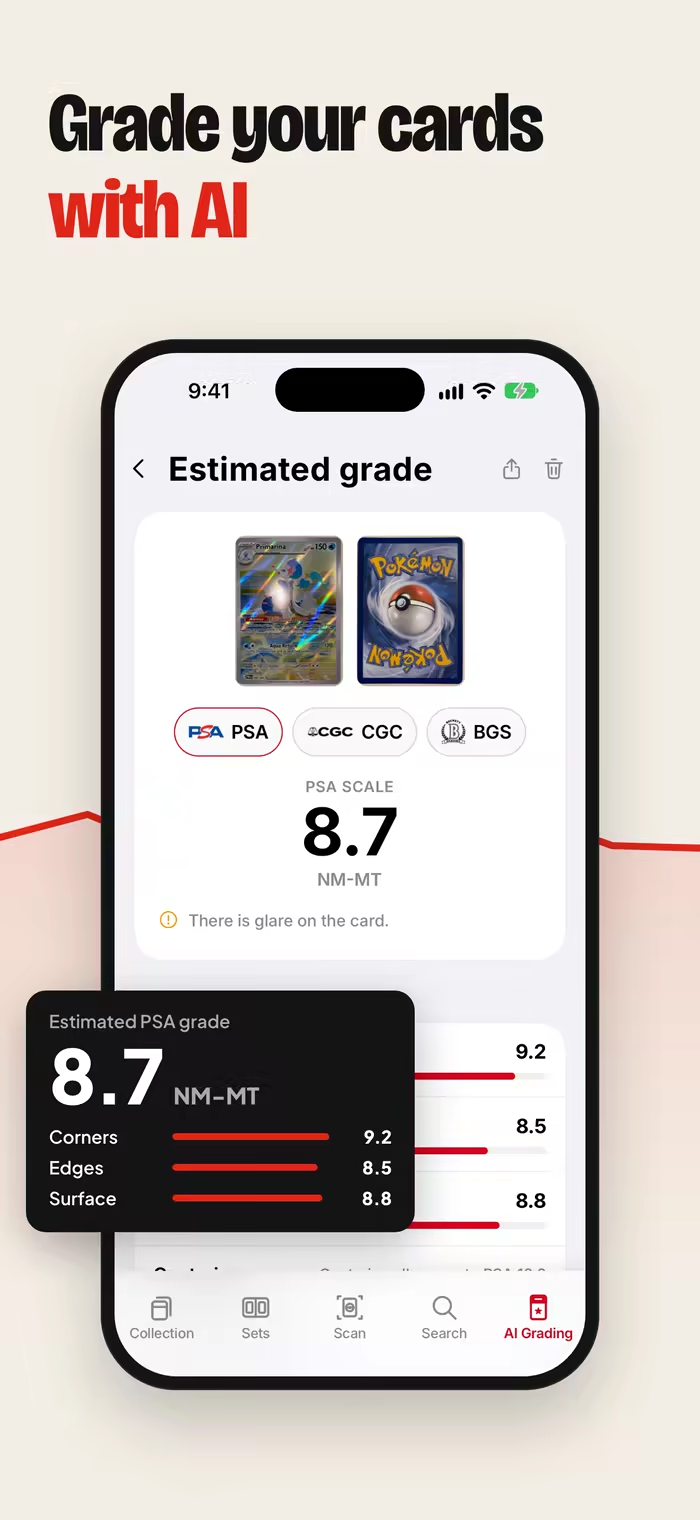
Strengths: three grading company scales on one result, flaws marked on your own photos, raw and graded prices under the grade, and the scanner, price checker and collection tracker in the same app.
Pricing: free to download. AI Grading is part of Cardex Premium (weekly, yearly or lifetime plans, with a free trial). Card search, raw prices and collection tracking are free.
Limitations: Pokémon only, and grading needs Premium or its free trial. Cardex doesn't publish an accuracy figure, and like every app here it works from photos, so glare or a sleeve can hide flaws.
See the AI card grader page for every screen.
2. Card Grader Pro: best for a human second opinion
Best for: collectors who want an AI estimate first and the option of a person looking at the card.
Card Grader Pro is the most-rated grading app on the US App Store, at 4.7 from 5,025 ratings. The AI estimate looks at centering, edges, corners and surface. Its listing offers an upgrade to human grading, where an expert reviews your card, writes condition notes and says whether the card is worth submitting to a grading company. The app also has a marketplace for buying and selling cards, a community showcase of graded cards and card prices.
Strengths: a large review base, the human review option, a built-in marketplace.
Pricing: Pro at $4.99 a month or $49.99 a year, Pro+ at $9.99 a month or $99.99 a year.
Limitations: the listing doesn't say which grading company's scale it predicts or how many free grades you get. It says it is an eBay Partner and may earn commission on purchases through links in the app.
3. Card Grading AI: best multi-game grader with a centering tool
Best for: collectors of several games who want a well-reviewed app with a separate centering check.
Card Grading AI (also called CGA) rates 4.8 from 628 US App Store ratings and has more than 100,000 installs on Google Play. You photograph the front and back and get an estimated grade with all four subgrades. A dedicated centering tool checks border alignment, and the Google Play listing says it measures left/right and top/bottom centering to the exact percentage. It keeps a grading history with digital slabs, a portfolio that follows estimated value, and lists such as "Best to Grade" for ideas. It covers Pokémon, sports cards, Magic, Yu-Gi-Oh! and Lorcana.
Strengths: strong ratings on both stores, front and back photos, the centering tool, several games.
Pricing: free to download, with in-app purchases from $9.99 to $59.99 and a $149.99 lifetime option. The store doesn't show billing periods or the number of free grades.
Limitations: the estimate isn't tied to a named grading company, and prices are a portfolio estimate rather than raw versus graded values for each card.
4. Digital Grading Co: the longest-running AI grader
Best for: collectors who want an established app and don't mind paying per grade.
Digital Grading Co has been on the App Store since July 2022 and rates 4.6 from 3,091 US ratings. Its website claims "over 10 million cards digitally graded". You photograph the card and get a report on centering, corners, edges and surface, with market insights and suggestions on whether to hold, trade or sell. It covers Pokémon, other TCGs and sports cards.
Strengths: track record, a large number of ratings, detailed condition reports.
Pricing: the company says plainly that it's a paid service. Credit packs start at $5 for 25 grades, and subscriptions are also available.
Limitations: no free grades, and the listing doesn't say which grading company's scale the report follows.
5. Midpoint: best for centering and TAG estimates
Best for: collectors who care most about centering, or who submit to TAG.
Midpoint finds the card and its print frame and shows live left/right and top/bottom centering ratios with millimetre offsets. Its AI grading takes front and back photos and returns an overall grade, subgrades and every defect called out with its location and a close-up, with predicted grades for PSA, BGS, CGC and TAG. Prices come from eBay sold listings, raw plus PSA 10, 9 and 8, with your estimated grade highlighted and a "worth grading?" verdict. It can also read the label on a slab you already own, and it sells shareable grade certificates in credit packs. It works on any standard trading card, Pokémon and sports included.
Strengths: the most detailed centering of the group, four grading companies, real sold prices at several grades.
Pricing: 2 free analyses to start, then subscriptions from $9.99 a week or $79.99 to $89.99 a year.
Limitations: it's new (July 2026) with 39 US ratings so far, and the weekly plan is expensive if you only grade now and then.
6. CardGrade.io: best for PSA, BGS and CGC predictions with a confidence score
Best for: collectors comparing grading companies who want to know how sure the app is.
CardGrade.io rates 4.8 from 324 US ratings. Its app asks for front and back photos and runs what it calls a 47-point inspection across 16 zones of the card. You get a 1 to 10 grade with sub-scores for centering, corners, edges and surface, a confidence score on every prediction, left/right and top/bottom centering measurements, and detected defects such as scratches, whitening, print lines and dents. It predicts PSA, BGS and CGC, shows market values for the predicted condition, and also runs on the web and as a Chrome extension.
Strengths: three grading companies, the confidence score, wide game coverage, a "2-grade credit-back guarantee" on its website.
Pricing: one free grade on the website. In the app, the Hobby and Starter monthly plans start with a 3-day trial including 5 grades, with a card on file. Monthly plans run from $4.99 to $74.99, yearly from $47.99 to $719.99.
Limitations: its website says web checkout is paused, so you subscribe in the app. The website also says one photo is enough while the app asks for two.
7. CardGrader.AI: best for grading live through the camera
Best for: checking a stack quickly without taking photos one by one.
CardGrader.AI's Live Grade reads corners, edges, surface and centering as you move the card in front of the camera and shows a grade on screen in seconds, with per-corner and per-edge subgrades. It then pulls real sold prices for raw and graded copies and makes a grade-it-or-not call using your own grading fee and minimum value. It covers Pokémon and sports cards and can list cards on eBay from the app. It rates 4.7 from 429 US ratings.
Strengths: live scanning, per-corner detail, sold prices, a grading decision based on your own costs.
Pricing: your first scan is free, and price lookups and set checklists stay free. In-app purchases range from $5.99 to $119.99.
Limitations: it predicts PSA only. Its "most precise AI card grader" line is its own claim.
8. Should I Grade It?: best for a few free checks a month
Best for: occasional graders who don't want to install anything.
Should I Grade It? runs in your phone's browser with no download and covers Pokémon only. It needs a front photo, with back and tilted photos optional, and returns a PSA estimate with subgrades and centering measured to the percent. Next to the grade it shows the TCGplayer raw price and eBay prices at the likely grade and at PSA 10.
Strengths: 7 free scans every month, no app to install, prices at the likely grade.
Pricing: after the free scans, $3.99 a month or $2.67 a month billed yearly. These are founding-member prices that the site says run until January 1, 2027.
Limitations: PSA scale only, and the back photo is optional, so remember to add it.
9. MasterGrade: best for free daily grades on a computer
Best for: grading from photos you already have, at a desk.
MasterGrade is a website, not a phone app. Upload a front photo (the back is optional) and it returns a PSA-style grade with four subgrades, a list of the defects it found, and the likelihood of each possible grade rather than a single number. It shows the card's value at each grade and covers Pokémon, Magic, Yu-Gi-Oh!, One Piece, Lorcana and sports cards.
Strengths: free daily grades, grade odds instead of one number, value at every grade.
Pricing: 1 free grade a day without an account and 5 a day with one. Packs cost $2.99 to $14.99, and Pro is $12.99 a month, $99 a year or $299 for life. The site calls these launch plans and says it leaves beta on December 1.
Limitations: no phone app, and the back photo is optional, so an estimate from the front alone misses half the card.
Other grading apps you'll come across
- CardMintAI is web only. You get one free grade at signup, then plans start at $10 a month for 20 grades. It claims 95% alignment with real PSA outcomes, which is its own figure.
- TCGrader is two unrelated products with the same name. tcgrader.com runs on the web and Android with one free credit; TCGrader on the iPhone App Store comes from a different developer and gives one free grade every 7 days.
- PokeGrade at pokegrade.org gives free PSA estimates on the web while in beta. The similar address pokegrade.ai now forwards to a different free tool, OneGrade.
- AGS Collector is the app of AGS, a grading company that uses AI for its mail-in grading. Its store listing mentions instant pre-grading, but neither the listing nor the website gives the scale or the price.
Are AI grading apps accurate?
Partly. A phone photo is good at the things that are geometry: the width of each border, a bent corner, whitening along a dark edge. It's weak on what a grader sees by tilting the card under a lamp and a loupe: fine scratches on a holo, print lines, a soft dent, a corner that's only slightly rounded. That's why every app here, ours included, labels its result as an estimate.
We haven't found an independent test that ran the same cards through these apps and compared them with real PSA results. The figures you'll see, such as CardMintAI's 95%, come from the vendors themselves, and CardGrade.io offers a credit-back guarantee instead of a number. Even the grading companies don't agree card for card: the same card can come back a 9 at one and a 10 at another.
You can test an app yourself in a few minutes:
- Grade one card twice with fresh photos. If the estimate moves by more than half a grade, the photos are probably the problem, not the card.
- Run the same card through two apps. If they agree, trust the estimate more. If they disagree by a full grade, look at the flaws each one marked.
- Grade a card you already know. If you photographed a card before sending it in, run those photos and compare with the grade that came back.
How to get a better estimate from any app
- Take the card out of its sleeve and toploader. Plastic adds glare and hides edge wear.
- Use soft, even light. A window with no direct sun works well. A single lamp overhead makes a bright spot that hides holo scratches.
- Put the card on a dark, plain background. Whitening on the edges stands out against it, and the app finds the outline more easily.
- Hold the phone flat above the card and fill the frame. A tilted shot stretches one border and throws off the centering ratio.
- Always photograph the back. PSA and CGC allow up to 75/25 centering on the back for a 10, and back edges often have the worst whitening. Our centering guide lists each company's limits.
- Check the marked flaws by hand. Tilt the card under a light at the spot the app flagged. If it's real, you've found what will cost the grade.
Which Pokémon card grading app should you choose?
- You want to know if grading will pay: an app that shows prices at the predicted grade: Cardex, Midpoint, CardGrader.AI or Should I Grade It?. Then run the numbers in our grading profit calculator.
- You submit to more than one company: Cardex (PSA, CGC, Beckett), CardGrade.io (PSA, BGS, CGC) or Midpoint (adds TAG).
- You want a person to look at it: Card Grader Pro's paid human grading.
- You collect sports cards too: Card Grading AI, Card Grader Pro, Digital Grading Co, CardGrader.AI or Midpoint.
- You only grade a few cards a year: the free tiers of Should I Grade It? or MasterGrade.
- You also want a scanner, prices and a collection tracker: Cardex covers all three for Pokémon. Our scanner app comparison covers that side in detail.
Whichever app you use, the estimate is only half the decision. About a third of the English Pokémon cards PSA has graded came back as 10s, and the rate varies a lot by set, so check the PSA 10 gem rate for your card's set and compare raw and graded prices before you pay a grading fee.
Estimate a grade with Cardex
Two photos give you an estimated grade on the PSA, CGC or Beckett scale, every flaw marked, and the raw and graded prices for that card. iPhone, iPad and Android.


Grading app questions
What is the best app to grade Pokémon cards?
It depends on what you need next. Cardex suits Pokémon collectors who want the grade estimate, raw and graded prices and a collection tracker in one app. Card Grader Pro and Card Grading AI are the most-rated grading apps on the US App Store and cover sports cards too. Midpoint is the most detailed on centering and adds TAG estimates.
Is there a free Pokémon card grading app?
Most grading apps charge after a few free grades, but some free options are generous. Should I Grade It? allows 7 free scans a month in your phone's browser, MasterGrade gives 1 free grade a day on the web (5 with an account), Midpoint starts you with 2 free analyses and CardGrader.AI makes your first scan free. PokeGrade.org offers free PSA estimates on the web while in beta.
Are AI card grading apps accurate?
They're good at measuring centering and spotting obvious whitening, and weaker on fine surface scratches, print lines and dents that a phone photo can't show. No independent test has compared these apps on the same cards. The accuracy figures you'll see, such as CardMintAI's 95% alignment with PSA, are the vendors' own claims.
Can an app give my Pokémon card an official PSA grade?
No. Only PSA, CGC, Beckett, TAG and the other grading companies can assign an official grade, after they handle the card. Every app here gives an estimate from photos, and all of them say a professional grade may differ.
Which grading app estimates PSA, CGC and BGS grades?
Cardex lets you switch the result between the PSA, CGC and Beckett scales. CardGrade.io predicts PSA, BGS and CGC, and Midpoint predicts PSA, BGS, CGC and TAG. CardGrader.AI and Should I Grade It? estimate on the PSA scale only.
Should I grade a card if the app says it's a 10?
Not on the estimate alone. Check the card's raw and PSA 10 prices and the gem rate for its set first. PSA's Standard tier cost $59.99 a card when we last checked, so a card needs a large gap between its raw price and its PSA 10 price before grading pays. The grading profit calculator does the math.