 Cardex
Quick answer: read a Pokémon card top to bottom. The top row shows the stage, name, HP (hit points) and type symbol. The middle shows the artwork, any Ability, and the attacks with their energy cost and damage. The bottom shows weakness, resistance and retreat cost, then the small print: illustrator, set symbol, set code, collector number, rarity symbol, regulation mark and copyright.
Every Pokémon card follows the same layout, whether it was printed in 1999 or last month. Once you know where each piece of information lives, you can identify a card, judge its rarity and understand how it plays in under a minute. This guide walks through the card in the order you would read it, then explains the types chart, the acronyms and the letters and numbers that trip most people up.
The anatomy of a Pokémon card, top to bottom
1. Stage and evolution line (top left)
The small label above the name reads Basic, Stage 1 or Stage 2. Stage 1 and Stage 2 cards also show a tiny picture and the words "Evolves from" with the previous form, for example "Evolves from Charmeleon". Special mechanics add their own tag here or after the name: ex in the current era, V, VMAX and VSTAR in Sword & Shield, GX in Sun & Moon, EX in XY. Cards with these tags are usually worth more than the plain version of the same Pokémon and give the opponent extra Prize cards when knocked out.
2. Name and HP (top center and right)
The name is the Pokémon's name, sometimes with a regional or owner prefix such as "Paldean Wooper" or "Team Rocket's Mewtwo". The number next to it followed by HP is the card's hit points: how much damage it can take before it is knocked out. HP here has nothing to do with card condition. In a marketplace listing, HP means Heavily Played; on the card, it always means hit points.
3. Type symbol (top right)
The colored circle next to the HP is the card's type, which decides which Energy cards power it and which weaknesses it has. The whole card frame is tinted in the same color, which is why people ask what the color of a Pokémon card means. The full list is in the types chart below.
4. Artwork and illustrator
The picture takes up the middle of the card. The illustrator's name is printed in tiny text just below the art box on older cards and in the bottom left on modern cards, after "Illus." Some artists carry a premium of their own, and Illustration Rare cards exist purely for the artwork, so this line matters more than it looks.
5. Ability
A red Ability header (called Poké-Power or Poké-Body on older cards) marks a passive effect that does not cost Energy. Not every card has one. Read it before the attacks, because it often changes how the card is played.
6. Attacks, energy cost and damage
Each attack has three parts: the energy cost shown as small type symbols on the left, the attack name and effect text in the middle, and the damage number on the right. A cost of two Fire symbols and one Colorless symbol means you need two Fire Energy plus one Energy of any type attached. A damage number followed by "+" or "×" means the text explains how the number changes.
7. Weakness, resistance and retreat cost (bottom)
The row under the attacks shows three things. Weakness (a type symbol and ×2) means attacks of that type deal double damage. Resistance (a type symbol and −30) means attacks of that type deal less. Retreat cost (a row of Colorless symbols) is how many Energy you discard to move the Pokémon to the bench. A blank space means the card has none.
8. The small print: set symbol, set code, collector number, rarity and regulation mark
The bottom edge is where collectors spend most of their time, because this is the part that identifies the exact card and its rarity:
- Set symbol: a tiny icon unique to each expansion.
- Set code: three letters in a box on cards from 2020 onward, such as SVI, PAF or MEG. Our guide to identifying a card's set lists every current code.
- Collector number: 081/244 means card 81 of 244. A first number larger than the second marks a secret rare.
- Rarity symbol: circle, diamond, star or a combination of black, silver, gold or pink stars. Every symbol is pictured in the rarity symbols chart.
- Regulation mark: a single letter in a box (D, E, F, G, H, I) that shows tournament legality. It has no effect on value.
- Copyright line: the year range and publisher. "Wizards" in this line means a 1999 to 2003 card; "Pokémon" means later.
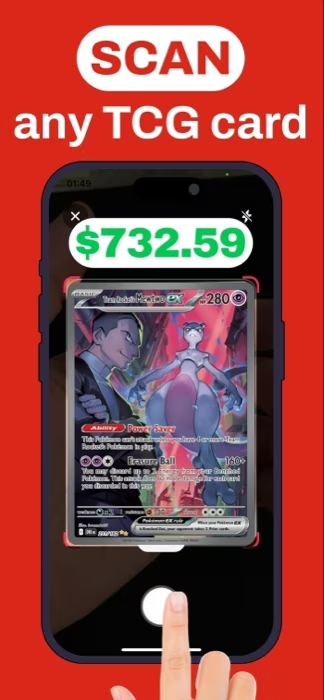
Let the app read the card
Cardex identifies the exact card, set, rarity and variant from your camera, then shows its current market price. Free on iPhone, iPad and Android.


Pokémon card types chart
There are eleven types in the English trading card game. The type symbol sits next to the HP, and the card frame takes the same color. The type decides which Energy powers the card, not how rare it is.
| Type | Symbol and frame color | Typical Pokémon | Energy card |
|---|---|---|---|
| Grass | Green leaf | Bulbasaur, Sprigatito, bug and plant Pokémon | Grass Energy |
| Fire | Red flame | Charmander, Fuecoco | Fire Energy |
| Water | Blue drop | Squirtle, Quaxly, most Ice Pokémon | Water Energy |
| Lightning | Yellow bolt | Pikachu, Pawmi | Lightning Energy |
| Psychic | Purple eye | Mewtwo, Gengar, most Ghost, Fairy and Poison Pokémon | Psychic Energy |
| Fighting | Orange-brown fist | Machop, Rock and Ground Pokémon | Fighting Energy |
| Darkness | Black crescent | Umbreon, Absol, most Poison Pokémon in recent sets | Darkness Energy |
| Metal | Silver hex | Steelix, Metagross | Metal Energy |
| Dragon | Gold dragon | Dragonite, Rayquaza | None, uses two other types |
| Colorless | White star | Eevee, Snorlax, Normal and Flying Pokémon | Any Energy |
| Fairy | Pink Y shape | Sylveon, Clefairy (2013 to 2019 only) | Fairy Energy, retired |
Fairy type was retired in 2020 and those Pokémon are now printed as Psychic. Older Base Set era cards used the same ten original types minus Darkness, Metal, Fairy and Dragon, which were added later.
Pokémon card acronyms and letters explained
Listings, forums and price sites use a lot of shorthand. This table decodes the ones you will meet most often.
| Acronym | Meaning |
|---|---|
| ex (lowercase) | Pokémon ex, the current era's powered-up cards (2023 onward). Gives up two Prize cards. |
| EX (uppercase) | Pokémon-EX from the XY era (2014 to 2016). |
| GX | Pokémon-GX from Sun & Moon (2017 to 2019), with a once-per-game GX attack. |
| V, VMAX, VSTAR | Sword & Shield era powered-up cards (2020 to 2023). |
| LV.X, BREAK, Prime, LEGEND | Older mechanics from the Diamond & Pearl, XY and HeartGold & SoulSilver eras. |
| Tera | Terastal Pokémon ex, with a crystal-style artwork frame and protection on the Bench. |
| RR, AR, SAR, UR | Japanese rarity codes: Double Rare, Illustration Rare, Special Illustration Rare, Hyper Rare. |
| IR, SIR, HR | English shorthand for Illustration Rare, Special Illustration Rare and Hyper Rare. |
| RH | Reverse holo: the frame shines instead of the artwork. |
| TG, GG | Trainer Gallery and Galarian Gallery subsets, numbered separately (TG12/TG30). |
| SVP, SWSH, MEP | Promo numbering prefixes for the Scarlet & Violet, Sword & Shield and Mega Evolution eras. |
| NM, LP, MP, HP, DMG | Condition grades: Near Mint, Lightly Played, Moderately Played, Heavily Played, Damaged. See condition abbreviations. |
| PSA, CGC, BGS | Grading companies. "PSA 10" is a card graded Gem Mint by PSA. |
| 1st Ed | First Edition, a stamp on early Wizards of the Coast era print runs. |
| WOTC | Wizards of the Coast, publisher of English cards from 1999 to 2003. |
| TCG | Trading Card Game. |
What do the letters in the box mean?
Modern cards have two boxed codes near the collector number. Three letters (such as OBF or PRE) are the set code. One letter (such as G, H or I) is the regulation mark, which tells tournament players whether the card is legal in the current Standard format. Neither affects the card's value, but the set code is the fastest way to identify which set a card is from.
What do Pokémon card levels mean?
Cards from the Diamond & Pearl and Platinum era (2007 to 2010) print a level after the name, such as "Pikachu LV.12". The level is flavor text that mirrors the video games and has no effect on gameplay, except for LV.X cards, which were a separate mechanic that leveled up a Pokémon in play. Modern cards do not show a level. If someone asks about "levels" on a current card, they usually mean the stage (Basic, Stage 1, Stage 2) or the rarity tier.
What do the numbers on a Pokémon card mean?
- The number next to HP is hit points.
- The numbers next to attacks are damage.
- The fraction in the bottom corner is the collector number and set size. This is the number to use when searching for the card's price.
- The year in the copyright line narrows the era.
- A number after a promo prefix (SVP 044) identifies a promo card rather than a booster set card.
Reading an old card versus a modern card
The layout has stayed remarkably stable, but a few things moved. Base Set era cards show the illustrator under the art box, put the rarity symbol in the bottom right, have no set code and no regulation mark, and Base Set itself has no set symbol at all. Cards from 2020 onward moved most of the small print to the bottom left, added the set code and regulation mark, and switched Poké-Powers to Abilities. If a card looks like a modern reprint of vintage artwork, it is usually from Celebrations (2021) or 151 (2023), and it is priced as a modern card.
Questions about reading Pokémon cards
What does HP mean on a Pokémon card?
Hit points, the damage the Pokémon can take before being knocked out. In a sales listing, HP instead means Heavily Played condition.
What does the color of a Pokémon card mean?
The frame color matches the card's type: green for Grass, red for Fire, blue for Water, yellow for Lightning, purple for Psychic, orange-brown for Fighting, black for Darkness, silver for Metal, gold for Dragon and white or grey for Colorless. Gold-framed cards across the whole card, not just the type, are Hyper Rares.
What does ex mean on a Pokémon card?
A Pokémon ex is a stronger version with more HP that gives the opponent two Prize cards when knocked out. Lowercase ex is the current era; uppercase EX is the older XY era mechanic.
How can I tell what a Pokémon card is?
Read the collector number and set code in the bottom corner, then search that combination. Or scan the card with Cardex, which identifies the exact card, set, rarity and variant from a photo.
How do I know if a Pokémon card is rare?
Check the rarity symbol next to the collector number. A star or multiple stars means Rare or higher. The rarity symbols chart pictures every tier, and how much is my Pokémon card worth explains how rarity turns into a price.